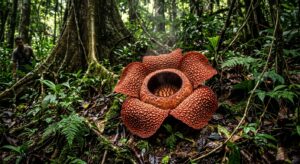
Deep in the rainforests of Sumatra, a botanical monster lurks beneath the forest floor. For years, it remains hidden, growing silently in the darkness. Then, without warning, it erupts from the earth in a spectacular display that combines beauty, horror, and one of nature’s most extreme survival strategies.
Meet the Amorphophallus titanum, better known as the corpse flower or titan arum. This isn’t just any ordinary plant with an unpleasant odor. This is a biological furnace that generates more heat than any other plant on Earth, all in service of creating a smell so putrid it can make grown adults vomit.
A Plant That Burns From Within
When the corpse flower decides to bloom, something remarkable happens inside its towering structure. The plant’s central spike, called a spadix, begins to heat up dramatically. Scientists have measured temperatures reaching up to 98°F (37°C), roughly equivalent to human body temperature, but for a plant, this is absolutely extraordinary.
To put this in perspective, most plants operate at ambient temperature or just slightly above. The corpse flower doesn’t just warm up a little, it becomes a botanical blast furnace. The temperature differential between the spadix and the surrounding air can be as much as 32°F (18°C). Imagine a tree branch that’s hot enough to feel warm to the touch in a cool forest, and you’ll begin to understand how unusual this phenomenon really is.
This intense heat generation requires an enormous amount of energy. During its peak heating period, which lasts about 12 hours, a single corpse flower can consume oxygen at a rate comparable to a small mammal. The plant literally burns through its stored energy reserves like a sprinter running the race of their life.
The Science Behind the Stink
But why does a plant need to become a furnace? The answer lies in chemistry and the physics of smell. The corpse flower’s notorious odor comes from a cocktail of sulfur compounds, including dimethyl trisulfide, isovaleric acid, and trimethylamine. These are the same chemicals that give rotting meat, sweaty socks, and decaying fish their distinctive aromas.
Here’s where the heat becomes crucial: warm molecules move faster than cold ones. By heating up these stinky compounds, the plant volatilizes them, meaning it transforms them from relatively stable forms into gas molecules that can travel through the air. The hotter the spadix gets, the more aggressively these odor molecules bounce around and spread outward.
The process works like a perfume atomizer, but instead of creating a pleasant mist, it creates an invisible cloud of putrid gas that can travel hundreds of yards from the plant. Visitors to botanical gardens have reported detecting the smell from parking lots before even entering the building where a corpse flower is blooming.
Nature’s Most Effective Marketing Campaign
This combination of heat and stench serves a very specific purpose: attracting carrion beetles and flesh flies. These insects normally feed and lay eggs on dead animals, so they’re naturally drawn to anything that smells like rotting meat. When they arrive at the corpse flower expecting to find a carcass, they instead find themselves crawling around inside a flower, inadvertently picking up pollen and transferring it to other plants.
The timing is critical. The corpse flower only blooms for about 24 to 48 hours, and it only has this brief window to accomplish reproduction. The intense heat helps ensure that the smell travels as far as possible as quickly as possible, maximizing the chances of attracting pollinators during this narrow timeframe.
A Giant Among Plants
The corpse flower’s heat production is made even more impressive by its sheer size. These plants can grow to over 10 feet tall during blooming, with the entire structure supported by a single underground corm (similar to a bulb) that can weigh over 150 pounds. When you consider that this massive plant generates its heat without any external energy source, relying entirely on stored starches and sugars, the achievement becomes even more remarkable.
The plant’s enormous leaf, which can span 15 feet across when not blooming, spends years collecting sunlight and storing energy in the underground corm. All of this stored energy gets deployed during the brief blooming period, much of it converted directly into heat.
Rare Encounters in the Wild
In their native Sumatra, corpse flowers are becoming increasingly rare due to deforestation. A individual plant might only bloom every few years, and finding one in the wild during its brief flowering period requires extraordinary luck. This rarity has made blooming corpse flowers major attractions at botanical gardens worldwide.
When a corpse flower is about to bloom in captivity, it often draws crowds of thousands. People line up for hours, sometimes traveling hundreds of miles, just to experience the plant’s legendary stench. Botanical gardens have learned to set up special viewing areas and even livestreams to accommodate the crowds that gather whenever one of these remarkable plants decides to put on its show.
Engineering Lessons From a Stinking Flower
Scientists continue to study exactly how the corpse flower generates so much heat so efficiently. The process involves rapidly breaking down starches and sugars in specialized cells, but the exact mechanisms are still being researched. Understanding how plants can generate controlled heat could potentially inform developments in biotechnology and sustainable heating systems.
The corpse flower represents one of nature’s most extreme examples of biological engineering in service of reproduction. It’s a reminder that evolution can produce solutions that seem almost impossibly specialized, turning a plant into a temporary furnace just to spread a smell that most animals find absolutely revolting.
Next time you catch a whiff of something unpleasant, remember that somewhere in the world, a plant is working harder than almost any other living thing to create an even worse smell, burning through years of stored energy in just a few hours to ensure its species survives for another generation.