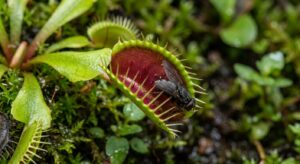
In the seemingly peaceful world of wetlands and bogs, a botanical predator lurks among the moss and reeds. The sundew plant might look like an innocent flowering herb adorned with sparkling dewdrops, but those glistening orbs are actually deadly traps. What makes this carnivorous plant truly extraordinary isn’t just its ability to catch and digest insects, but its remarkable capacity to count.
Yes, you read that correctly. Scientists have discovered that sundews can actually count the number of times an insect touches their sticky tentacles before deciding whether to invest energy in closing their trap. This mathematical marvel of the plant kingdom challenges everything we thought we knew about plant intelligence and decision-making.
The Deceptive Beauty of Death Traps
Sundews belong to the genus Drosera, with over 190 species found across every continent except Antarctica. These carnivorous plants have evolved one of nature’s most ingenious hunting strategies. Their leaves are covered in hundreds of tiny tentacles, each tipped with a droplet of sticky mucilage that sparkles like morning dew in the sunlight.
When unsuspecting insects land on the leaf, attracted by the moisture or the plant’s sweet scent, they become stuck in this natural flypaper. But here’s where the story gets fascinating: the plant doesn’t immediately spring into action. Instead, it begins counting.
The Mathematics of Survival
Research conducted by botanists has revealed that sundews require multiple stimuli before activating their energy-intensive trapping mechanism. When an insect struggles against the sticky tentacles, each movement sends a signal through the plant’s tissue. The sundew literally counts these signals, typically requiring between two to five touches within a specific time frame before committing to the capture process.
This counting ability serves a crucial evolutionary purpose. Closing the trap and beginning digestion requires significant energy expenditure. By counting touches, the plant can distinguish between a substantial meal worth the investment and a false alarm, such as a raindrop or piece of debris that might trigger the tentacles only once.
The Biochemical Computer
But how does a plant without a nervous system perform mathematical calculations? The answer lies in the sundew’s sophisticated biochemical signaling network. When tentacles are stimulated, they release calcium ions that spread through the leaf tissue like electrical impulses through neural pathways.
These calcium waves create a temporary biochemical memory, allowing the plant to “remember” previous stimulations for up to several minutes. When the threshold number of touches is reached within the critical time window, the plant triggers a cascade of responses that bend the tentacles inward, wrapping around the prey like grasping fingers.
Energy Economics in the Plant Kingdom
The sundew’s counting behavior represents a perfect example of evolutionary optimization. These plants typically grow in nutrient-poor environments where every calorie counts. The ability to make informed decisions about when to invest energy in prey capture provides a significant survival advantage over plants that react to every minor disturbance.
Studies have shown that sundews can adjust their counting thresholds based on their current nutritional status. A well-fed plant might require more touches before responding, while a hungry sundew becomes more sensitive and may react to fewer stimuli. This adaptive flexibility demonstrates a level of behavioral sophistication rarely associated with plant life.
The Capture Process Revealed
Once the counting threshold is met, the sundew initiates its remarkable capture sequence. The process unfolds in several distinct phases:
- Initial Response: Tentacles closest to the prey begin bending toward the struggling insect within seconds
- Enzymatic Activation: Digestive enzymes are released from specialized glands
- Structural Changes: The leaf may curl slightly to create a more secure prison
- Sustained Capture: The plant maintains its grip for days or weeks until digestion is complete
Throughout this process, the sundew continues to monitor the situation. If the prey escapes early in the sequence, the plant can abort the expensive capture process and reset its tentacles to their original hunting position.
Implications for Plant Intelligence
The discovery of counting ability in sundews has profound implications for our understanding of plant cognition. It demonstrates that plants can process information, make decisions based on multiple inputs, and exhibit what can only be described as primitive learning behavior.
This challenges the traditional view of plants as passive organisms that simply react to stimuli. Instead, it reveals a hidden world of plant intelligence where biochemical processes create sophisticated behavioral responses that mirror decision-making patterns found in animals with nervous systems.
Nature’s Efficiency Expert
The sundew’s counting strategy represents millions of years of evolutionary fine-tuning. In environments where resources are scarce and competition is fierce, the ability to make smart decisions about energy expenditure can mean the difference between survival and extinction.
These remarkable plants remind us that intelligence takes many forms in nature. While sundews may lack brains or nervous systems, they possess their own sophisticated methods for processing information and making complex decisions. Their ability to count insect movements and respond accordingly showcases the incredible ingenuity of evolutionary adaptation.
The next time you encounter a sundew sparkling with dewdrops in a bog or wetland, remember that you’re looking at one of nature’s most sophisticated botanical mathematicians, quietly counting its way to survival in the competitive world of carnivorous plants.