The Mathematical Revolution That History Almost Forgot
Picture this: while ancient Greeks were still grappling with basic arithmetic, Babylonian mathematicians were already solving quadratic equations and calculating compound interest with sophisticated algebraic methods. This isn’t some revisionist fantasy, it’s archaeological fact backed by thousands of cuneiform tablets that reveal one of history’s most underappreciated intellectual achievements.
For centuries, we’ve credited the ancient Greeks with laying the foundations of modern mathematics. Names like Pythagoras, Euclid, and Archimedes dominate our textbooks, while the true pioneers of algebra remain largely forgotten. But recent archaeological discoveries and advanced translation techniques have shattered this misconception, revealing that the Babylonians were solving complex mathematical problems as early as 2000 BCE, a full millennium and a half before Greek mathematics reached its golden age.
Cracking the Code: What the Tablets Revealed
The evidence lies buried in thousands of clay tablets discovered throughout Mesopotamia, written in cuneiform script and baked hard by time and desert heat. These aren’t just accounting records or royal decrees, they’re sophisticated mathematical textbooks that would make a modern algebra student sweat.
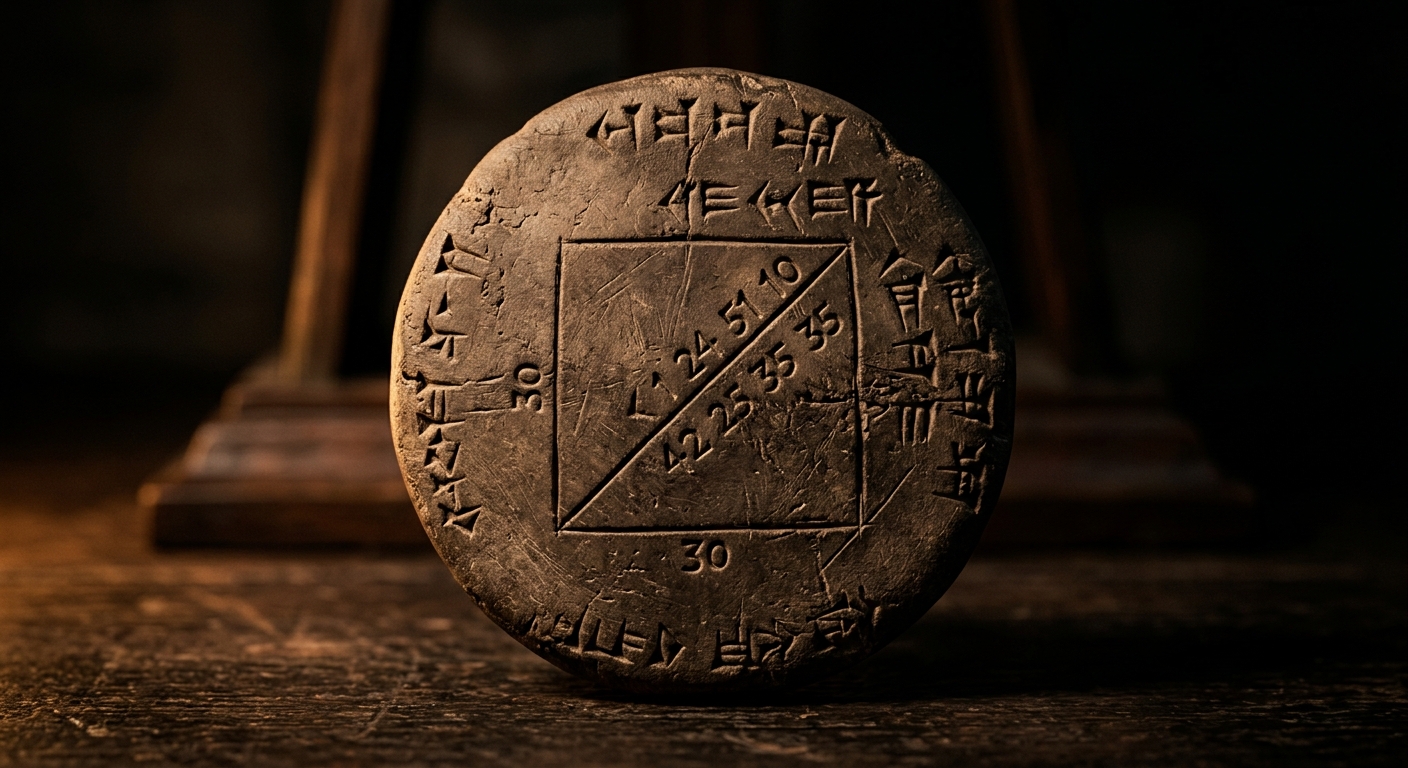
One of the most remarkable discoveries is tablet YBC 7289, housed at Yale University. This small clay square contains calculations for the diagonal of a square with unprecedented accuracy. The Babylonians calculated the square root of 2 to six decimal places: 1.414213, compared to the actual value of 1.414214. This level of precision wouldn’t be achieved again in the Western world for over 1,000 years.
The Plimpton 322 Mystery
Perhaps even more astounding is the famous Plimpton 322 tablet, which contains what appears to be a sophisticated table of Pythagorean triples. These are sets of three numbers that satisfy the famous theorem a² + b² = c². The tablet lists 15 such triples, including some with numbers in the millions. The mathematical sophistication required to generate these numbers suggests the Babylonians understood principles that wouldn’t be formally recognized in Europe until the Renaissance.
What makes this discovery particularly mind-blowing is that it predates Pythagoras himself by over 1,000 years. The theorem we associate with the Greek philosopher was already old news to Babylonian students learning from clay tablets in ancient Mesopotamia.
Beyond Basic Arithmetic: Advanced Problem Solving
The Babylonians didn’t just stumble upon these mathematical insights by accident. They developed systematic approaches to solving problems that we would recognize today as algebraic thinking. Their methods for solving quadratic equations were remarkably similar to techniques taught in modern high school algebra classes.
Consider this problem from a Babylonian tablet: “I have subtracted the side of my square from the area, and the result is 870. What is the side of my square?” In modern notation, this translates to x² – x = 870. The Babylonian solution method involves a step-by-step process that mirrors our contemporary approach to completing the square.
Real-World Applications
This wasn’t mathematics for its own sake. The Babylonians applied their algebraic knowledge to solve practical problems that would be familiar to any modern engineer or economist:
- Compound Interest Calculations: They calculated how long it would take for money to double at various interest rates
- Land Surveying: Complex geometric calculations for irregularly shaped fields and plots
- Construction Projects: Determining material quantities and structural requirements for buildings and canals
- Astronomical Predictions: Mathematical models for predicting celestial events with remarkable accuracy
- Trade and Commerce: Sophisticated calculations for profit margins, currency exchange, and business partnerships
The Base-60 Advantage
One factor that gave Babylonian mathematicians a significant advantage was their use of a base-60 number system, rather than our familiar base-10 system. While this might seem cumbersome at first glance, it actually provided remarkable computational advantages for certain types of calculations.
The number 60 has 12 divisors (1, 2, 3, 4, 5, 6, 10, 12, 15, 20, 30, 60), compared to only 4 divisors for our base-10 system (1, 2, 5, 10). This made fraction calculations much more straightforward and contributed to their ability to work with complex mathematical relationships.
Interestingly, we still use remnants of the Babylonian base-60 system today. Our division of hours into 60 minutes, minutes into 60 seconds, and circles into 360 degrees all trace back to ancient Mesopotamian mathematics.
Why History Got It Wrong
So why did Greek mathematicians receive all the credit for so long? The answer lies in a combination of cultural bias, language barriers, and historical accident. Greek mathematical texts were preserved and transmitted through Islamic scholars during the Middle Ages, eventually making their way back to European universities. Meanwhile, Babylonian cuneiform tablets lay buried in desert ruins, waiting for archaeologists to rediscover them.
Additionally, Greek mathematics emphasized geometric proofs and theoretical foundations in a way that appealed to later European scholars. Babylonian mathematics, while more advanced in many practical applications, was primarily focused on problem-solving techniques rather than abstract mathematical theory.
Rewriting Mathematical History
The implications of these discoveries extend far beyond academic curiosity. They force us to reconsider our understanding of human intellectual development and challenge Western-centric narratives about the origins of mathematical thinking.
The Babylonians weren’t just competent calculators, they were innovative mathematical thinkers who developed sophisticated techniques for solving complex problems. Their work laid crucial groundwork for later developments in mathematics, astronomy, and engineering that would eventually flow through Persian, Islamic, and European scholarly traditions.
As we continue to decode more tablets and refine our understanding of Babylonian mathematics, one thing becomes increasingly clear: the next time you solve an algebraic equation or calculate compound interest, you’re using techniques that were already ancient when Pythagoras was born. The true pioneers of mathematical thinking weren’t working in marble academies in ancient Greece, they were scratching calculations into clay tablets in the cradle of civilization, pushing the boundaries of human knowledge one cuneiform symbol at a time.