
In the depths of tropical and subtropical waters around the world, a creature no bigger than your thumb wields one of nature’s most devastating weapons. The pistol shrimp, also known as the snapping shrimp, possesses the ability to create a cavitation bubble that reaches temperatures of 4,400°C (7,952°F) – nearly as hot as the surface of the sun.
This isn’t science fiction. This is the extraordinary reality of Alpheus species, tiny crustaceans that have evolved one of the most powerful hunting mechanisms in the animal kingdom. What makes this even more mind-blowing? They accomplish this feat with nothing more than a specialized claw and the physics of water.
The Anatomy of Destruction
The pistol shrimp’s secret weapon lies in its asymmetrical claws. One claw is significantly larger than the other and features a unique structural design that would make any engineer jealous. The larger claw has a movable finger that fits into a socket on the fixed finger, creating a specialized snapping mechanism.
When the shrimp contracts its muscles, the movable finger is held in place by a locking mechanism. Pressure builds up until the finger suddenly releases, snapping shut at incredible speed. This isn’t just a simple pinch – the claw closes so rapidly that it creates a high-velocity water jet.
The Physics Behind the Power
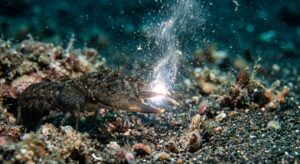
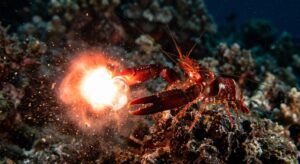
The real magic happens in the water itself. When the claw snaps shut, it creates a cavitation bubble – essentially a void in the water where the pressure drops so dramatically that water vapor forms. This bubble travels at speeds of up to 60 miles per hour toward the shrimp’s target.
Here’s where things get truly extraordinary: when this bubble collapses, it creates a shockwave that produces:
- Temperatures reaching 4,400°C (hotter than lava)
- Pressures of 80 kilopascals
- A flash of light called sonoluminescence
- A sound that can reach 200 decibels underwater
To put this in perspective, the sound is louder than a gunshot and can be heard by underwater microphones from over a mile away. The light flash, though lasting only nanoseconds, is created by the extreme conditions inside the collapsing bubble.
Hunting with Superpowers
This incredible mechanism serves a deadly purpose. The pistol shrimp uses its cavitation bubble to stun or kill prey. Small fish, crabs, and other crustaceans don’t stand a chance against this underwater sonic boom. The shockwave alone is often enough to knock out prey, making them easy targets for the shrimp to grab with its other claw.
But the pistol shrimp isn’t just a mindless killing machine. These creatures are surprisingly intelligent hunters that can accurately aim their cavitation weapon. They position themselves strategically and can adjust their aim based on the size and distance of their target.
The Unexpected Side Effects
The pistol shrimp’s snapping is so loud that it actually interferes with sonar and underwater communication systems. During World War II, submarines used to hide near beds of snapping shrimp because the constant crackling sounds provided acoustic camouflage against enemy sonar.
Even today, marine biologists and naval engineers have to account for the noise pollution created by these tiny creatures. In some tropical waters, the collective snapping of pistol shrimp populations creates a constant background noise that can mask other sounds in the ocean.
A Symbiotic Partnership
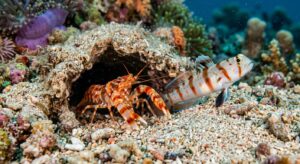
Many species of pistol shrimp have formed one of nature’s most fascinating partnerships with gobies – small fish that serve as the shrimp’s eyes and early warning system. The nearly blind shrimp maintains a burrow in the sand, while the goby fish hovers near the entrance, watching for predators.
This partnership is so refined that the shrimp keeps one antenna in constant contact with the goby. When danger approaches, the fish signals by flicking its fins, and both creatures retreat into the burrow. In return for this security service, the shrimp shares its home and food with the goby.
Engineering Inspiration
The pistol shrimp’s remarkable ability hasn’t gone unnoticed by human engineers. Researchers are studying the mechanics of cavitation bubble creation to develop new technologies, including:
- More efficient cleaning systems
- Advanced medical treatments using focused shockwaves
- Improved propulsion systems
- Novel materials processing techniques
The shrimp’s ability to create such extreme conditions using only biological materials and water pressure could revolutionize how we approach energy concentration and release in mechanical systems.
Living Among Giants
What makes the pistol shrimp even more remarkable is that despite wielding one of nature’s most powerful weapons, they’re often found in home aquariums. Many aquarium enthusiasts unknowingly house these tiny creatures in their reef tanks, where they continue their snapping behavior – though usually at a much quieter volume due to the smaller space.
These shrimp play a crucial role in their ecosystems, helping to control populations of small fish and crustaceans while creating complex burrow systems that provide shelter for other marine life. Their constant activity helps aerate the sediment on the ocean floor, contributing to the health of their marine communities.
The next time you’re near a tropical coastline or visiting an aquarium with reef displays, listen carefully. That subtle crackling sound you might hear isn’t electrical equipment – it’s the sound of one of nature’s most incredible predators creating temperatures hotter than the sun, one snap at a time.


I’m so curious what it’s actually *like* for the pistol shrimp to perceive that snap, you know? Like, does it experience the cavitation bubble as a distinct event or is the whole hunting sequence just one fluid motion to its nervous system? We’re so focused on the physical specs (rightfully, they’re insane) but I wonder if their sensory world is organized completely differently from ours, and that’s why they can reliably use a weapon that literally explodes next to them without constant injury.
Log in or register to replyThat cavitation bubble temperature is absolutely wild, and what’s even crazier is how recent that discovery was – we’ve only really understood the thermodynamics in the last couple decades. I pick up rocks from our local beaches and sometimes find these guys in tidal pools, and I always think about how they’re basically creating these tiny violent events that would’ve been impossible for early life forms to survive around, yet here they are thriving. The fact that this mechanism has been perfecting itself since at least the Mesozoic era, long before humans even thought to use it for submarine camouflage, just shows how evolution solved some incredibly complex physics problems way before we did.
Log in or register to replyThis is wild, I had no idea about the WWII sonar thing! I’ve actually seen pistol shrimp in shallow reef environments and you’re right that the snap is loud enough to hear while diving, but hearing that it reaches 4,400°C makes me appreciate what’s happening even more. It’s one of those reminders that reefs have these incredibly sophisticated predator-prey relationships we’re still learning about, which is partly why losing reef biodiversity hits so hard when bleaching events wipe out entire ecosystems.
Log in or register to reply