
In the vast depths of our oceans, a creature no larger than your thumb wields a superpower so extraordinary that it can interfere with the most sophisticated military technology on Earth. The pistol shrimp, also known as the snapping shrimp, possesses a claw capable of creating one of the most violent phenomena in the animal kingdom, and when these tiny warriors gather in colonies, they become an accidental force capable of disrupting submarine communications across entire ocean regions.
The Biological Cannon
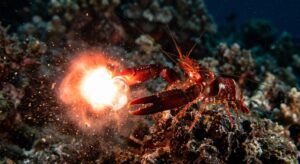
The pistol shrimp’s oversized claw operates like a biological version of a high-powered rifle. When the shrimp snaps its specialized appendage shut, it creates a cavitation bubble that collapses with such force that it produces temperatures reaching nearly 4,700 degrees Celsius, hotter than the surface of the sun. This violent implosion generates a shockwave traveling at speeds of up to 60 miles per hour and creates a sound that can reach 210 decibels, louder than a gunshot.
This incredible feat of bioengineering serves multiple purposes in the shrimp’s daily life:
- Stunning prey with the shockwave force
- Defending territory from intruders
- Communicating with other colony members
- Creating burrows by loosening sediment
When Colonies Create Chaos
Individual pistol shrimp are impressive enough, but the real drama unfolds when thousands of these creatures gather in dense colonies along coastal areas and continental shelves. These underwater neighborhoods become acoustic battlegrounds where the constant symphony of snapping claws creates what marine biologists call “shrimp noise” or “biological static.”
During peak activity periods, particularly at dawn and dusk when the shrimp are most active, colonies can produce a wall of sound so intense that it overwhelms sensitive underwater listening equipment. The collective cacophony of hundreds of thousands of simultaneous snaps creates a broadband acoustic interference that spans the exact frequency ranges used by submarine sonar and communication systems.
The Submarine Problem
Modern submarines rely heavily on sophisticated sonar systems for navigation, detection, and communication. These systems operate using sound waves that travel through water at specific frequencies. When pistol shrimp colonies are active, they essentially create an underwater acoustic fog that can:
- Mask the sonar signatures of other vessels
- Interfere with submarine-to-surface communications
- Disrupt underwater navigation systems
- Overwhelm passive listening devices
- Create false targets on sonar displays
Naval forces have documented cases where entire submarine operations had to be relocated or postponed due to excessive biological noise from pistol shrimp populations. The interference is so significant that military oceanographers now include “biological acoustic conditions” in their operational planning.
Historical Naval Encounters
During World War II, Allied submarines operating in the Pacific encountered mysterious acoustic phenomena that initially puzzled military scientists. Sonar operators reported overwhelming background noise in certain regions that made it nearly impossible to detect enemy vessels or navigate safely. It wasn’t until decades later that researchers identified massive pistol shrimp colonies as the culprits behind these acoustic blackouts.
The phenomenon became so well-documented that military forces began mapping pistol shrimp habitats as potential natural camouflage zones. Submarines could theoretically use these noisy areas to mask their own acoustic signatures, though the same interference that provides concealment also blinds their own detection systems.
The Science Behind the Interference
The acoustic interference created by pistol shrimp colonies operates across multiple levels of complexity. Each individual snap produces a broadband acoustic pulse containing energy across a wide range of frequencies. When thousands of shrimp snap simultaneously, the overlapping sound waves create constructive and destructive interference patterns that can completely scramble underwater acoustic signals.
Research has shown that the collective noise from large colonies can exceed 140 decibels across frequencies ranging from 2 to 200 kHz, which encompasses most submarine communication and sonar frequencies. The random, chaotic nature of the snapping makes it nearly impossible to filter out using traditional signal processing techniques.
Geographic Impact Zones
Pistol shrimp colonies create acoustic interference zones in specific geographic regions where conditions favor their population growth:
- Warm tropical and subtropical coastal waters
- Coral reef systems with abundant hiding places
- Rocky substrates suitable for burrow construction
- Areas with strong tidal flows that bring abundant prey
- Continental shelf regions with depths between 10-200 meters
Modern Military Adaptations
Contemporary naval forces have developed sophisticated strategies to cope with biological acoustic interference. Advanced signal processing algorithms can partially filter out shrimp noise, while improved sonar systems use multiple frequency bands to maintain functionality even in high-interference environments.
Military oceanographers now maintain detailed databases of seasonal pistol shrimp activity patterns, allowing submarine commanders to predict and plan around periods of peak biological noise. Some naval exercises are specifically scheduled during low-activity periods when shrimp colonies are less acoustically active.
The Broader Ecological Picture
The ability of pistol shrimp colonies to disrupt human technology highlights the incredible acoustic complexity of marine ecosystems. These tiny creatures represent just one component of an underwater soundscape that includes whale songs, dolphin clicks, fish choruses, and countless other biological sounds that collectively create one of Earth’s most dynamic acoustic environments.
Climate change and ocean acidification threaten pistol shrimp populations, potentially altering the acoustic characteristics of marine environments in ways that could have unexpected consequences for both military operations and marine ecosystem health.
The next time you hear about advanced submarine technology, remember that somewhere in the ocean depths, colonies of thumb-sized shrimp are carrying on their daily lives, completely unaware that their natural behaviors can bring the world’s most sophisticated underwater vehicles to a standstill. In the eternal arms race between human technology and nature’s ingenuity, sometimes the smallest players wield the most surprising power.



I love the enthusiasm here, and you’re absolutely right to pump the brakes on that sonar jamming claim – the cavitation bubbles are real and spectacular, but the submarine interference is pretty speculative! What IS genuinely mind-blowing is that pistol shrimp use those snaps for hunting and communication within their own colonies, which honestly makes them way cooler than a hypothetical weapons scenario. I’ve been wanting to get macro footage of the actual snap mechanics in action, but getting close enough without spooking them is the real challenge!
Log in or register to replyThis is such a wild example of how incredible biodiversity actually functions at scales we’re only beginning to understand! I’m curious though if the “jamming submarine sonar” part is more speculative, since I’ve read the cavitation bubbles from pistol shrimp snaps are insanely powerful for hunting tiny prey in tight spaces, but I’m not sure about the large-scale acoustic interference claims. Either way, it reminds me of visiting the Amazon and realizing how much of the rainforest canopy operates on communication frequencies and sensory systems we can barely detect, let alone comprehend – nature’s engineering puts our tech to shame sometimes.
Log in or register to replyokay so i’ve literally seen pistol shrimp in action on dives and the snapping sound is absolutely INSANE, like you feel it in your chest, but yeah i gotta back up trevor and becca here – the submarine jamming thing is way more hollywood than hard science. that said, what really gets me is how noisy our oceans have become with ship traffic and sonar, and we’re not even sure how that’s messing with creatures whose whole world depends on sound and light signals. the shrimp are incredible enough without the exaggeration!
Log in or register to reply