
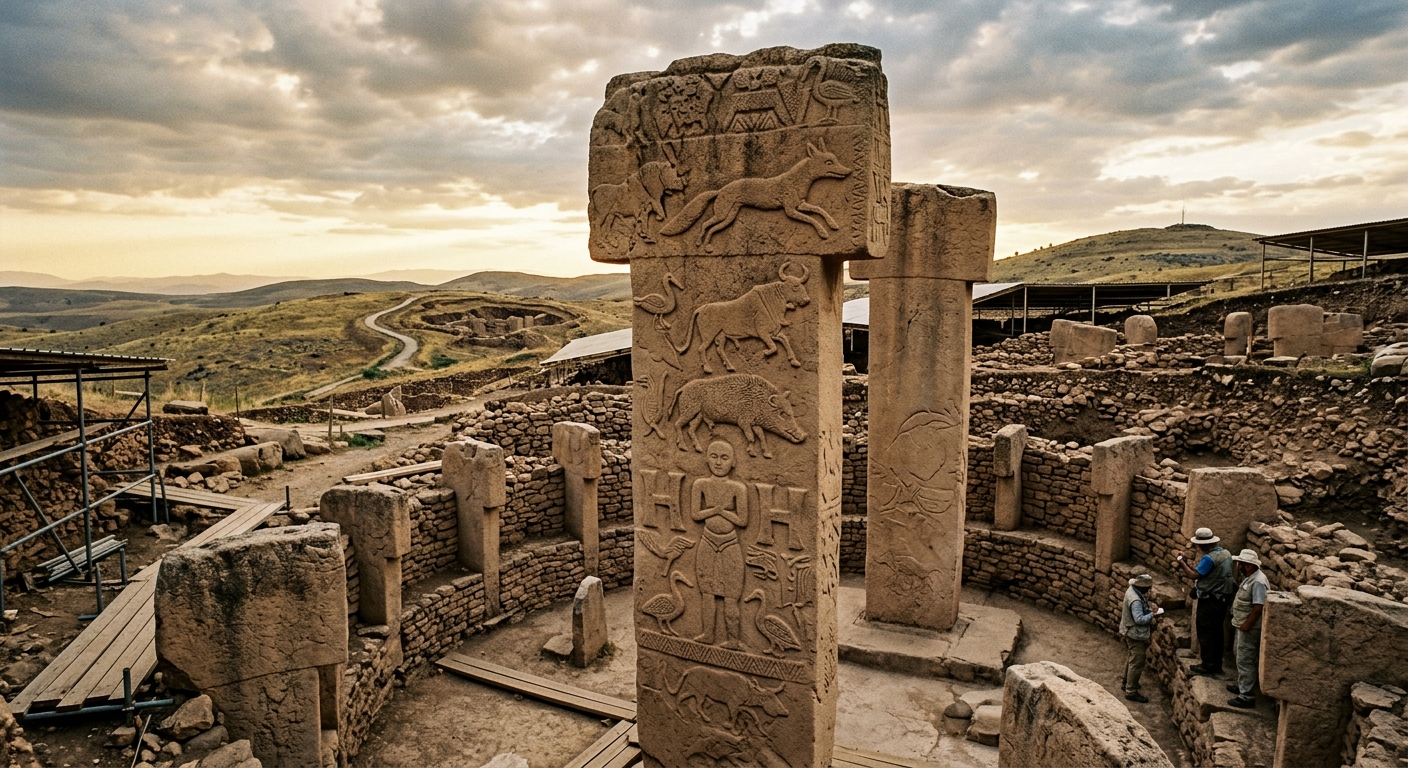
Deep in the rolling hills of southeastern Turkey lies a discovery so profound that it has forced archaeologists to completely rewrite the story of human civilization. Gobekli Tepe, a massive stone temple complex dating back over 12,000 years, challenges everything we thought we knew about our ancestors and their capabilities.
The Discovery That Changed Everything
When German archaeologist Klaus Schmidt first laid eyes on Gobekli Tepe in 1994, he knew he was looking at something extraordinary. What he found buried beneath centuries of sediment would turn the archaeological world upside down: intricately carved stone pillars arranged in perfect circles, some weighing up to 20 tons, decorated with elaborate reliefs of animals and mysterious symbols.
But here’s what makes this discovery truly mind-blowing: Gobekli Tepe predates Stonehenge by about 6,000 years and the Egyptian pyramids by 7,000 years. To put this in perspective, when the pyramids of Giza were being built, Gobekli Tepe was already ancient history.
The Impossible Timeline
According to traditional archaeological thinking, humans 12,000 years ago were supposed to be simple hunter-gatherers, barely capable of basic tool-making, let alone constructing massive stone monuments. The conventional timeline suggested that complex architecture and organized religion only emerged after the development of agriculture and settled communities.
Gobekli Tepe completely destroys this narrative. Here was a sophisticated temple complex built by people who hadn’t yet invented pottery, metalworking, or even the wheel. The precision of the stonework, the complexity of the carvings, and the sheer scale of the construction project suggest a level of organization and planning that wasn’t supposed to exist for thousands more years.
The Numbers That Don’t Add Up
- Over 200 massive stone pillars arranged in circles
- Individual pillars weighing between 10-20 tons
- Construction spanning several centuries
- Evidence of coordinated effort by hundreds of workers
- Sophisticated knowledge of astronomy and engineering
A Gallery of Ancient Mysteries
Walking through Gobekli Tepe today feels like stepping into an alien world. The T-shaped pillars, some standing over 18 feet tall, are covered in intricate carvings of animals that seem to dance across the stone surface. Lions, bulls, foxes, snakes, vultures, and scorpions are all represented with stunning detail and artistic sophistication.
But perhaps most intriguing are the pillars that appear to represent stylized human figures, complete with arms, hands, and clothing details carved into the stone. Some archaeologists believe these may represent gods, spirits, or ancestral figures, suggesting that complex religious beliefs were already well-developed 12,000 years ago.
The Agricultural Revolution Connection
One of the most fascinating theories about Gobekli Tepe is its potential connection to the birth of agriculture. The site is located in what researchers call the “cradle of agriculture,” where wild wheat was first domesticated. Some scientists now wonder if the need to feed large groups of people working on this massive construction project may have actually driven the development of farming.
This turns our understanding of human development completely on its head. Instead of agriculture leading to complex society, complex society may have led to agriculture. The implications are staggering: our ancestors may have been far more sophisticated and organized than we ever imagined.
The Deliberate Burial Mystery
Here’s where the story gets even stranger. Around 8,000 years ago, the entire complex was deliberately buried under tons of earth and debris. This wasn’t natural erosion or abandonment; it was a conscious decision to hide this magnificent structure from the world.
Why would anyone want to bury such an incredible achievement? Theories range from climate change forcing abandonment to religious reasons, or perhaps the rise of new belief systems that saw the old temples as dangerous or obsolete. Whatever the reason, this deliberate burial preserved Gobekli Tepe for millennia, waiting for modern archaeologists to uncover its secrets.
Rewriting Human History
The discovery of Gobekli Tepe has forced archaeologists to reconsider fundamental assumptions about human development. The site proves that hunter-gatherer societies were capable of far more complex organization, planning, and artistic achievement than previously thought possible.
This has opened up exciting new questions: If humans could build Gobekli Tepe 12,000 years ago, what other sophisticated achievements might be waiting to be discovered? How many other sites like this exist, still buried and unknown? And perhaps most intriguingly, what happened to the knowledge and skills that created this masterpiece?
The Ongoing Mystery
Despite decades of excavation, archaeologists estimate they’ve only uncovered about 5% of the Gobekli Tepe site. Ground-penetrating radar suggests there are many more structures waiting to be revealed, each potentially holding new secrets about our ancient past.
As we continue to excavate and study Gobekli Tepe, one thing becomes increasingly clear: our ancestors were far more remarkable than we ever dared to imagine. This ancient temple complex stands as a testament to human ingenuity, creativity, and spiritual sophistication that stretches back to the very dawn of civilization itself.





that’s such a cool angle frank, i bet they have looked into that but its def not something that gets the same headlines as the temple itself. honestly this kind of stuff makes me think we should be paying way more attention to what indigenous fire management practices tell us about land stewardship over thousands of years. if you’re into digging deeper into early human behavior, you might check out citizen science projects around historical ecology or even just documenting fire adapted plants in your own area on iNaturalist, sometimes the best insights come from noticing these patterns locally first.
Log in or register to replyThis is such a cool thread! Frank’s point about fire management really resonates with me because it connects to something I see all the time with bats, actually – we massively underestimate what earlier humans understood about their environment and the creatures around them. Bats have been roosting in human structures for thousands of years, and there’s evidence early peoples recognized their value as pest control, but we act like ancient people were just terrified of everything that flew at night. Anyway, great reminder that our ancestors were way more sophisticated than we give them credit for!
Log in or register to replyThis is really fascinating stuff, and I appreciate how archaeology keeps humbling us about what early humans could accomplish. I’m curious though if anyone’s looked at whether controlled fire management played a role in maintaining the landscape around Gobekli Tepe, since we know hunter-gatherers were sophisticated fire users across the globe. Not trying to make it all about fire ecology, but those open gathering spaces would’ve been way more functional if people were actively burning to keep vegetation in check and promote the kinds of plants and game animals they needed.
Log in or register to reply