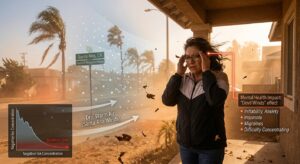
In the high desert of northern New Mexico, something extraordinary is happening. Something that challenges our understanding of sound, perception, and the very nature of reality itself. Welcome to Taos, where approximately 2% of residents and visitors report hearing a persistent, low-frequency humming sound that has no identifiable source – a phenomenon so mysterious it has baffled scientists, government investigators, and acoustic experts for decades.
The Sound That Shouldn’t Exist
Imagine lying in bed at night, trying to sleep, when suddenly you become aware of a distant rumbling – like a diesel truck idling outside your window. You get up to investigate, but there’s nothing there. The sound seems to emanate from everywhere and nowhere at once. You ask your family if they hear it too, but they look at you with confusion and concern. This is the reality for those who experience the Taos Hum.
First documented in the 1990s, though likely existing long before, the Taos Hum is described by those who hear it as a low-pitched, continuous droning sound. Some compare it to:
- A distant diesel engine running
- Industrial machinery operating miles away
- The rumble of heavy machinery underground
- A low-flying aircraft that never passes
- The electrical hum of power lines, but much deeper
What makes this phenomenon truly bizarre is its selectivity. While some people are tormented by this constant noise, the vast majority of the population – including sensitive recording equipment – detects absolutely nothing.
The Scientific Investigation
The mystery became so compelling that in 1997, a team of scientists, including researchers from Los Alamos National Laboratory, Sandia National Laboratories, and the University of New Mexico, launched an official investigation. Their mission: to identify the source of the Taos Hum once and for all.
The research team employed state-of-the-art equipment, including:
- Sensitive seismic monitoring devices
- Electromagnetic field detectors
- Acoustic recording equipment capable of detecting infrasound
- Geophysical survey instruments
After months of intensive investigation, their conclusion was as puzzling as the phenomenon itself: no external source could be identified. The equipment detected no unusual sounds, vibrations, or electromagnetic activity that could account for the reported humming.
The Hearers vs. The Non-Hearers
One of the most fascinating aspects of the study was the clear division between ‘hearers’ and ‘non-hearers.’ The research revealed several intriguing patterns among those who experience the hum:
- Age demographic: Most hearers are middle-aged or older
- Geographic clustering: Certain areas of Taos show higher concentrations of hearers
- Consistency: Those who hear it typically hear it continuously, not sporadically
- Health impact: Many report sleep disturbance, anxiety, and stress-related symptoms
Interestingly, some hearers reported that the sound would disappear when they traveled away from Taos, only to return upon their arrival back in the area.
Theories and Explanations
The lack of an external source hasn’t stopped scientists from proposing various theories to explain the Taos Hum phenomenon.
The Tinnitus Theory
Some researchers suggest that the Taos Hum might be a form of subjective tinnitus – sounds generated within the auditory system itself rather than by external sources. This could explain why recording equipment fails to detect it and why it affects only certain individuals.
Electromagnetic Sensitivity
Another theory proposes that some people may be unusually sensitive to electromagnetic fields from power lines, radio transmissions, or other electronic sources. The high desert environment around Taos, with its clear atmosphere and minimal electromagnetic interference, might somehow amplify this sensitivity.
Geological Activity
The unique geological features of the Taos area, including its position in the Rio Grande Rift, might generate subsonic vibrations that only certain individuals can perceive. These micro-seismic activities could create sound waves at frequencies just below normal human hearing threshold.
Mass Psychogenic Illness
Some skeptics propose that the Taos Hum might be a form of mass psychogenic illness – a psychological phenomenon where symptoms spread through a population despite having no identifiable physical cause. However, this theory struggles to explain the consistent geographical boundaries of the phenomenon.
A Global Mystery
Taos isn’t alone in harboring mysterious hums. Similar phenomena have been reported in locations around the world, including:
- Windsor, Ontario, Canada
- Bristol, England
- Kokomo, Indiana
- Largs, Scotland
- Bondi Beach, Australia
Each location has its own characteristics, but all share the same basic mystery: a persistent low-frequency sound that only some people can hear, with no identifiable external source.
Living with the Hum
For those who experience the Taos Hum, it’s far from an academic curiosity. Many report significant impacts on their quality of life, including:
- Chronic sleep disruption
- Increased stress and anxiety
- Difficulty concentrating
- Feelings of isolation and frustration
- Physical symptoms like headaches and fatigue
Some hearers have even relocated from Taos to escape the constant noise, while others have learned to cope through various methods including white noise machines, meditation, and support groups.
The Enduring Enigma
Despite decades of investigation, the Taos Hum remains one of our planet’s most perplexing mysteries. It challenges our understanding of sound, perception, and the complex relationship between our brains and the environment around us.
Perhaps the most mind-blowing aspect isn’t just that this mysterious sound exists, but that it reveals how differently we each experience the world around us. In a place where some people are driven to distraction by an omnipresent noise, others enjoy perfect silence. It’s a humbling reminder that reality itself might be far more subjective than we typically imagine.
The next time you visit Taos, take a moment to listen carefully. You might just be one of the lucky – or unlucky – 2% who can hear the desert’s most enigmatic secret.