Long before calculators, computers, or even the modern decimal system, ancient Egyptian mathematicians achieved something that would make today’s engineering students jealous: they calculated the value of pi (π) to an astounding five decimal places. This mathematical feat, accomplished over 4,000 years ago, reveals a level of mathematical sophistication that challenges our assumptions about ancient civilizations.
The Mathematical Marvel Hidden in Stone
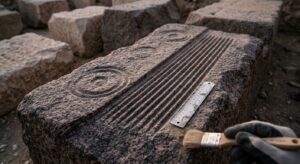
The Great Pyramid of Giza stands as more than just an architectural wonder. Its precise measurements encode mathematical knowledge that wouldn’t be matched in Europe for another 3,000 years. When archaeologists and mathematicians began analyzing the pyramid’s dimensions, they discovered something extraordinary: the ratio of the pyramid’s perimeter to its height equals 2π with remarkable accuracy.
The pyramid’s base perimeter measures approximately 921.4 meters, while its original height was 146.5 meters. This gives us a ratio of 6.2857, which translates to a π value of 3.14286. Compare this to the actual value of pi (3.14159), and you’ll find the ancient Egyptians were accurate to within 0.05% of the true value.
The Rhind Papyrus: Ancient Egypt’s Mathematical Textbook
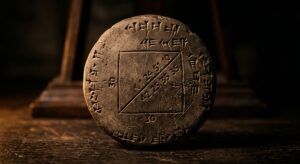
Our clearest evidence of Egyptian mathematical prowess comes from the Rhind Mathematical Papyrus, dating to around 1650 BCE. This ancient document, essentially a mathematics textbook, contains 87 problems and their solutions. Problem 50 specifically deals with calculating the area of a circle, and the method described gives π a value of approximately 3.16049.
The papyrus describes a method for finding the area of a circle by constructing a square with sides equal to 8/9 of the circle’s diameter. While this might seem like an odd approach to modern mathematicians, it demonstrates a sophisticated understanding of circular geometry and produces surprisingly accurate results.
Decoding Ancient Mathematical Thinking
The Egyptian approach to π reveals a practical, empirical method of mathematics. Rather than pursuing π as an abstract mathematical constant, they developed it as a tool for solving real-world problems. Their calculations needed to be accurate enough for:
- Constructing massive pyramids with perfect geometric proportions
- Calculating areas for agricultural land redistribution after Nile floods
- Designing circular granaries and storage facilities
- Creating accurate astronomical calendars
- Planning irrigation systems with curved channels
Comparing Ancient Accuracy to Historical Progress
To truly appreciate the Egyptians’ achievement, consider that medieval European mathematicians were still using crude approximations of π well into the 15th century. Many used simple ratios like 22/7 (giving 3.142857) or even rougher estimates like 3 or 25/8.
The Egyptian value of π remained more accurate than most European calculations until the Renaissance, when mathematicians like Ludolph van Ceulen spent decades calculating π to 35 decimal places. It’s remarkable that ancient builders achieved such precision using only basic tools and geometric principles.
The Tools of Ancient Mathematical Genius
How did Egyptian mathematicians achieve such accuracy without modern instruments? Their toolkit included:
- Rope stretchers: Professional surveyors who used knotted ropes to create perfect geometric shapes
- Plumb bobs and levels: For ensuring precise vertical and horizontal measurements
- Merkhet: Ancient astronomical instruments for tracking celestial movements
- Cubit rods: Standardized measuring sticks calibrated to incredible precision
Beyond Pi: A Mathematical Civilization
The accurate calculation of π represents just one aspect of Egyptian mathematical sophistication. These ancient scholars also developed:
Advanced fraction systems using unit fractions (fractions with numerator 1), sophisticated geometric formulas for calculating volumes of truncated pyramids, astronomical calculations precise enough to predict celestial events, and engineering mathematics capable of moving and positioning multi-ton stone blocks with millimeter accuracy.
The Mystery of Lost Knowledge
Perhaps the most intriguing aspect of ancient Egyptian π calculations is how much knowledge may have been lost to time. The mathematical papyri we’ve discovered likely represent only a fraction of their mathematical literature. Many scrolls were lost to fires, floods, and the simple passage of millennia.
Some researchers suggest that Egyptian mathematicians may have known π to even greater accuracy than the surviving records indicate. The precision required for their largest architectural projects hints at mathematical knowledge that approaches modern standards.
Modern Implications and Ongoing Mysteries
The ancient Egyptians’ mathematical achievements force us to reconsider the intellectual capabilities of early civilizations. Their accurate calculation of π wasn’t a lucky accident but the result of systematic mathematical thinking and careful empirical observation.
Recent archaeological discoveries continue to reveal new aspects of Egyptian mathematical knowledge. Ground-penetrating radar and 3D modeling of ancient structures show geometric relationships and mathematical principles that we’re still working to understand fully.
This ancient mathematical legacy reminds us that human intelligence and curiosity have remained constant throughout history. The tools may have changed, but the drive to understand and quantify our world spans millennia. The next time you use π in a calculation, remember that you’re employing mathematical knowledge first mastered by scholars working by lamplight along the banks of the Nile, over 4,000 years ago.