The Impossible Engineering Feat That Baffled Modern Scientists
When archaeologists first studied the precision-cut granite blocks of ancient Egyptian monuments, they faced a seemingly impossible puzzle. These massive stones, some weighing over 80 tons, had been sliced with laser-like precision using technology that shouldn’t have existed 4,500 years ago. The granite blocks at Giza, Karnak, and countless other sites showed cut marks so clean and precise that early researchers assumed metal tools must have been involved.
There was just one problem: the ancient Egyptians of the Old Kingdom period had no metal tools capable of cutting granite.
The Mystery of Granite: Earth’s Nearly Indestructible Stone
Granite ranks between 6 and 7 on the Mohs hardness scale, making it one of the most challenging materials to cut even with modern tools. This igneous rock, formed deep within the Earth’s crust under extreme heat and pressure, contains quartz, feldspar, and mica crystals that create an incredibly durable matrix.
To put this in perspective, granite is harder than steel (which ranks about 5.5 on the Mohs scale). Modern granite cutting requires diamond-tipped tools, high-powered water jets, or specialized carbide blades. Yet somehow, ancient Egyptian craftsmen were producing perfectly straight cuts, right angles, and even intricate curved surfaces in this nearly indestructible material.
The Scale of the Challenge
The engineering challenge becomes even more mind-boggling when you consider the scale of their work. The Great Pyramid alone contains an estimated 2.3 million stone blocks, many of them granite. The precision required was extraordinary, with joints so tight that you cannot slide a knife blade between adjacent blocks even today.
The Quartzite Revolution: Ancient Egypt’s Secret Weapon
The breakthrough in understanding came when archaeologists made a startling discovery: the ancient Egyptians had developed quartzite saws. These weren’t metal tools at all, but rather ingenious devices that used the hardness properties of minerals against each other.
Quartzite, a metamorphosed form of sandstone, ranks 7 on the Mohs hardness scale, making it slightly harder than granite. The Egyptians quarried this material from specific locations along the Nile and fashioned it into cutting implements that could slowly but effectively work through granite.
The Cutting Process Revealed
Evidence from archaeological sites reveals how these quartzite tools actually worked:
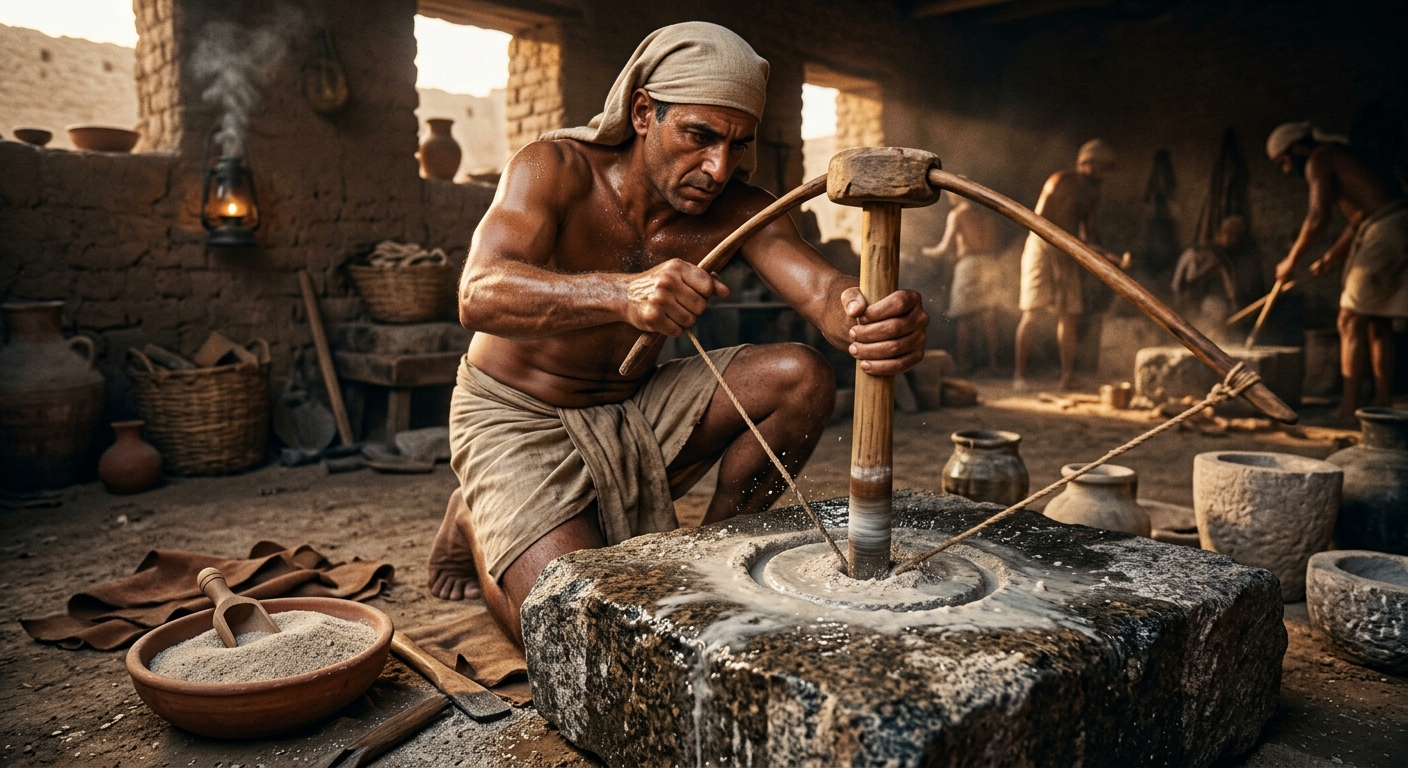
- Abrasive action: The quartzite didn’t cut like a modern blade but rather abraded the granite surface through repeated friction
- Sand and water lubrication: Fine sand mixed with water served as both lubricant and additional abrasive medium
- Copper tool frames: While copper couldn’t cut granite, it could hold quartzite cutting edges and provide structural support
- Team coordination: Multiple workers would operate these saws in coordinated motions, similar to using a two-person crosscut saw
Archaeological Evidence of Advanced Stone-Cutting Technology
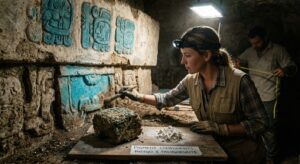
Modern investigations have uncovered compelling evidence of this sophisticated technology throughout Egypt. At the Aswan quarries, researchers found partially cut granite blocks with distinctive saw marks that match the patterns quartzite tools would create.
The Tell-Tale Marks
The granite surfaces show specific characteristics that reveal the cutting method:
- Parallel striations indicating steady, controlled cutting motion
- Gradual depth progression showing the slow abrasive process
- Corner cuts that demonstrate the ability to change cutting direction
- Surface smoothness that indicates finishing techniques using progressively finer abrasives
The Ingenious Quarrying Process
The process of extracting and shaping granite blocks required multiple stages of sophisticated technique. First, workers would identify natural fracture lines in the granite face. They would then use quartzite tools to create initial cuts along these lines, working gradually deeper over days or weeks.
For the final separation, they employed thermal shock techniques, heating the stone with fires and then rapidly cooling it with water. This would cause the granite to crack along the pre-cut lines, allowing massive blocks to be extracted intact.
Precision Shaping
Once extracted, the blocks underwent precision shaping using increasingly refined quartzite tools. Coarse quartzite removed large amounts of material quickly, while finer grades created smooth surfaces. The final polishing used quartzite powder mixed with water, creating the mirror-like finishes still visible on many ancient Egyptian granite surfaces.
Modern Implications and Lessons
This ancient technology offers fascinating insights for modern engineering. The quartzite cutting method, while slow, produced remarkably precise results without the energy requirements of modern power tools. Some experimental archaeologists have successfully recreated these techniques, confirming their effectiveness.
The discovery also reshapes our understanding of ancient technological capability. Rather than brute force or mysterious lost technologies, the Egyptians succeeded through systematic understanding of material properties and ingenious application of natural resources.
The Legacy of Stone Mastery
The quartzite cutting technology represents one of humanity’s earliest examples of precision engineering. These ancient craftsmen understood principles of hardness, abrasion, and material science that wouldn’t be formally codified until thousands of years later.
Their techniques were so effective that many granite structures they created remain perfectly intact today, having survived earthquakes, floods, and millennia of weathering. The precision they achieved using nothing but stone tools, sand, and water continues to amaze engineers and archaeologists alike.
This remarkable achievement reminds us that human ingenuity and persistence can overcome seemingly impossible challenges, even without modern technology. The ancient Egyptians didn’t need metal blades to conquer granite: they just needed to understand the secret that stone could cut stone, given enough time, skill, and determination.