Hidden away on one of the most remote islands on Earth lies a mystery that has puzzled linguists and archaeologists for over a century. Easter Island, known locally as Rapa Nui, isn’t just famous for its towering stone statues. It’s also home to the rongorongo writing system, the only known indigenous script ever developed independently in all of Oceania.
A Script Unlike Any Other
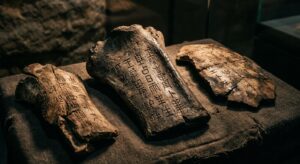
The rongorongo system consists of intricate glyphs carved into wooden tablets, ceremonial staffs, and other wooden objects. These mysterious symbols depict human figures, animals, plants, and geometric shapes, all arranged in neat rows across the surface. What makes this discovery so extraordinary is that it represents the only example of true writing to emerge naturally from the vast Pacific region, covering thousands of islands across millions of square miles of ocean.
The name “rongorongo” itself comes from the Rapanui language, roughly translating to “to recite” or “to chant.” This hint at its oral connection has proven crucial in understanding how this writing system might have functioned in ancient Polynesian society.
The Great Language Mystery
Here’s where the story becomes truly mind-bending: despite decades of intensive study, no one has successfully deciphered rongorongo. The script remains one of archaeology’s greatest unsolved puzzles. Researchers have identified approximately 600 distinct symbols, but their meanings remain locked away in the wooden tablets.
The challenge is compounded by the unique reading pattern of rongorongo. Unlike most writing systems that read left-to-right or top-to-bottom, rongorongo follows a pattern called “reverse boustrophedon.” Readers would start at the bottom left corner, read to the right, then flip the tablet 180 degrees and continue reading the next line from left to right again. This serpentine reading pattern is almost unprecedented in world writing systems.
What We Know About the Symbols
While the full meaning eludes us, researchers have identified several fascinating patterns in the rongorongo glyphs:
- Human figures appear frequently, often in various poses and activities
- Birds feature prominently, particularly the frigatebird, which held special significance in Rapanui culture
- Fish and marine life reflect the island’s oceanic environment
- Geometric symbols that may represent celestial objects or abstract concepts
- Plant motifs including what appear to be palm trees and other vegetation
The Timeline of Discovery and Loss
The tragic irony of rongorongo is that it was likely still in use when European missionaries first arrived on Easter Island in the 1860s. However, the rapid cultural disruption that followed, including the conversion to Christianity and the devastating slave raids that removed much of the island’s population, led to the loss of the knowledge needed to read these ancient texts.
By the time researchers realized the significance of these wooden tablets, the last people who could read them had already passed away. The French missionary Eugène Eyraud first documented the script in 1864, describing wooden tablets “covered with hieroglyphic characters” that he observed in nearly every house on the island.
The Remaining Artifacts
Today, only about 25 authentic rongorongo objects survive, scattered across museums worldwide. These precious artifacts include:
- Wooden tablets of various sizes
- Ceremonial staffs with carved inscriptions
- A reimiro (crescent-shaped pectoral ornament)
- Fragments of larger objects that didn’t survive intact
Theories About Its Purpose
Without the ability to read rongorongo, scholars have developed several theories about its function in Rapanui society. Some researchers believe it served as a mnemonic device, helping chanters remember long oral traditions, genealogies, or ceremonial procedures. Others suggest it might have recorded astronomical observations, which were crucial for navigation and agricultural timing on the isolated island.
The most intriguing theory proposes that rongorongo tablets contained the island’s creation myths, historical chronicles, and perhaps even records of the original Polynesian migration that brought people to Easter Island around 1200 CE.
Modern Decipherment Efforts
Despite the challenges, researchers haven’t given up on cracking the rongorongo code. Modern computational linguistics, pattern recognition software, and comparative studies with other Polynesian languages continue to offer new hope. Some scholars have claimed partial successes, identifying possible calendrical sequences and repeated phrases that might represent common ceremonial formulas.
The work is painstaking because researchers must rely entirely on the physical artifacts and the few 19th-century accounts from people who claimed to remember fragments of the tradition. Every new analysis must be carefully cross-referenced against the limited corpus of surviving texts.
Why It Matters Today
The rongorongo script represents more than just an archaeological curiosity. It stands as a testament to human ingenuity and the independent development of complex symbolic systems. The fact that this sophisticated writing system emerged on one of the world’s most isolated inhabited islands challenges our assumptions about how and where literacy develops.
Furthermore, rongorongo reminds us of the fragility of human knowledge and culture. An entire writing tradition, possibly containing centuries of accumulated wisdom, disappeared within a few generations due to cultural disruption and the failure to pass knowledge to younger generations.
As we continue to study these mysterious symbols, rongorongo serves as both an inspiration and a warning: a brilliant achievement of human creativity that we may never fully understand, lost in the vast expanse of the Pacific Ocean on the world’s most remote inhabited island.