The Weapon That Rewrote the Rules of Naval Warfare
Imagine flames that dance on water, refusing to die even when submerged beneath the waves. Picture enemy ships desperately trying to douse fires with seawater, only to watch in horror as the flames grow stronger. This wasn’t fantasy or fiction: this was Greek fire, the most terrifying and mysterious weapon of the medieval world.
For nearly seven centuries, the Byzantine Empire wielded a secret so powerful it changed the course of history. Greek fire burned on water, couldn’t be extinguished by conventional means, and struck such fear into enemies that many battles were won before they even began. Yet today, despite centuries of investigation, the exact formula remains one of history’s greatest unsolved mysteries.
The Birth of an Unstoppable Flame
The story begins in 672 CE, when a Syrian refugee named Kallinikos arrived in Constantinople with knowledge that would transform the dying Byzantine Empire into a naval superpower. As Arab fleets pressed closer to the empire’s capital, Kallinikos presented Emperor Constantine IV with a weapon unlike anything the world had seen.
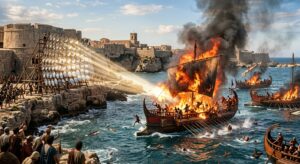
The first recorded use of Greek fire came during the Arab siege of Constantinople in 674-678 CE. Byzantine ships equipped with flame-throwing devices unleashed torrents of liquid fire that spread across the water’s surface. The Arab fleet, caught completely off guard, watched their wooden vessels become floating infernos. The psychological impact was devastating: sailors spoke of supernatural flames that pursued them like living creatures.
More Than Just Fire
What made Greek fire truly extraordinary wasn’t just that it burned on water, but how it behaved. Contemporary accounts describe flames that:
- Continued burning even when completely submerged
- Spread rapidly across water surfaces
- Stuck to whatever it touched like napalm
- Could only be extinguished with sand, vinegar, or urine
- Produced thick, choking smoke
- Made a thunderous roaring sound when deployed
The weapon was typically deployed through bronze tubes called siphons, mounted on the prows of Byzantine warships. These devices could shoot streams of liquid fire up to 15 meters, turning the sea itself into a weapon. Some accounts even describe handheld versions and fire grenades thrown by infantry.
The Ultimate State Secret
The Byzantine Empire understood they possessed something revolutionary, and they guarded the formula with unprecedented secrecy. Knowledge of Greek fire’s composition was restricted to the imperial family and a handful of trusted craftsmen. The secret was passed down through generations under oath, with severe penalties for anyone who revealed it.
This secrecy extended to manufacturing. Greek fire was produced in heavily guarded imperial workshops, and even the component ingredients were sourced through multiple suppliers to prevent anyone from deducing the complete formula. Workers involved in production were sworn to secrecy and often worked on only small portions of the process.
Diplomatic Consequences
The weapon’s secrecy became a matter of international relations. Emperor Constantine VII wrote extensively about the moral imperative to keep Greek fire away from foreign powers, describing it as a divine gift that must never be shared. When the Prince of Bulgaria requested the secret in the 10th century, the emperor refused, stating that revealing it would bring divine punishment upon the empire.
Scientific Theories and Modern Analysis
Despite the lost formula, modern scientists and historians have developed compelling theories about Greek fire’s composition. The key to its water-defying properties likely lay in a combination of several incendiary substances:
Petroleum-Based Foundation
Most experts believe the base was crude oil or naphtha, naturally occurring petroleum products abundant in the Middle East. These substances burn readily and float on water, explaining the flame’s ability to spread across the sea surface. The Byzantine Empire had access to petroleum deposits in the Black Sea region and through trade networks.
Chemical Additives
To achieve its unique properties, Greek fire likely contained additional chemicals:
- Quicklime (calcium oxide): Reacts violently with water, generating heat and potentially reigniting flames
- Sulfur: Burns with an intense flame and produces choking smoke
- Saltpeter (potassium nitrate): Acts as an oxidizer, making flames burn hotter and more persistently
- Pine resin or pitch: Helps the mixture stick to targets and burn longer
The Pressure System Mystery
Equally mysterious is how Greek fire was deployed. The siphon system required significant pressure to project liquid fire over long distances. Some theories suggest the Byzantines used bronze pumps, steam pressure, or even early chemical reactions to create the necessary force. Recent experiments have shown that heated petroleum can create enough vapor pressure for projection.
The Weapon That Changed History
Greek fire’s impact extended far beyond individual battles. The weapon effectively secured Byzantine naval supremacy for centuries, allowing the empire to survive when it might otherwise have fallen to Arab expansion. Major conflicts where Greek fire proved decisive include:
- The Arab sieges of Constantinople (674-678 and 717-718 CE)
- Multiple naval battles against the Rus’ (941 and 1043 CE)
- Conflicts with Norman and Italian maritime republics
- Various battles during the Crusades
The Secret Dies with an Empire
As the Byzantine Empire declined, so did the knowledge of Greek fire. By the 12th century, references to the weapon become increasingly rare. The Fourth Crusade’s sack of Constantinople in 1204 likely scattered the craftsmen and destroyed many imperial records. When Constantinople finally fell to the Ottomans in 1453, the last keepers of the secret perished with their empire.
The loss of this knowledge represents one of history’s most significant technological mysteries. Despite medieval attempts by other powers to recreate Greek fire, and centuries of modern scientific investigation, the exact formula remains elusive. We have theories, we have components, but we lack the precise combination and methodology that made Byzantine Greek fire so devastatingly effective.
Legacy of the Liquid Flame
Greek fire stands as a testament to both human ingenuity and the fragility of knowledge. In an age without written technical manuals or scientific journals, the loss of a few key individuals could erase centuries of innovation. The weapon that once ruled the seas became a ghost of history, leaving behind only tantalizing clues and the echo of ancient flames that danced on water and refused to die.
Today, as we develop new technologies and weapons, the story of Greek fire serves as a reminder that even the most revolutionary innovations can vanish without a trace, taking their secrets to the grave and leaving future generations to wonder at what was lost.