Deep beneath the forest floor of Oregon’s Blue Mountains lies something that will fundamentally change how you think about life on Earth. It’s not a massive redwood tree or a sprawling coral reef – it’s a single mushroom that has been quietly growing for millennia, now covering an area larger than 1,800 football fields combined.
Meet Armillaria ostoyae, better known as the “Humongous Fungus” – the largest living organism on our planet by area, and quite possibly one of the oldest living things in existence.
The Discovery That Shocked Scientists
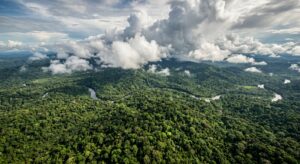
In 1998, researchers from the University of Washington made headlines when they announced their incredible discovery in the Malheur National Forest. What appeared to be separate mushroom patches scattered across 2,385 acres were actually all part of a single, massive organism connected by an underground network of root-like structures called rhizomorphs.
Using DNA testing, the team confirmed that this wasn’t just a colony of related fungi – it was literally one individual organism that had spread across an area roughly the size of 1,665 football fields. To put this in perspective, this single mushroom could cover half of Manhattan.
How Scientists Cracked the Code
The discovery required detective work that would make CSI investigators jealous. Researchers collected tissue samples from mushrooms found throughout the forest and analyzed their DNA. What they found was remarkable: despite being separated by miles, the samples were genetically identical – like finding your twin on the opposite side of a massive city.
This genetic fingerprinting revealed that what locals had long considered separate mushroom populations were actually fruiting bodies of the same underground super-organism, connected by a vast network of fungal threads called mycelia.
The Secret Underground Kingdom
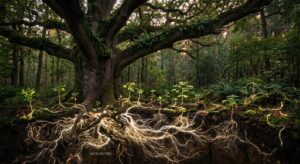
While we see mushrooms popping up above ground, the real action happens in the hidden world beneath our feet. The Humongous Fungus exists primarily as a sprawling network of mycelia – thread-like structures that spread through soil and decomposing organic matter like nature’s own internet.
These mycelia serve multiple purposes:
- Nutrient transportation: The network efficiently moves water, nutrients, and chemical signals across vast distances
- Resource sharing: Areas with abundant resources can support regions where food is scarce
- Communication: The fungus can coordinate growth and response to threats across its entire range
- Reproduction: When conditions are right, the network produces the mushrooms we see above ground
A Living Computer Network
Think of the Humongous Fungus as nature’s original world wide web. The mycelial network can process information, make decisions, and adapt to changing conditions. When one section encounters a food source, it can communicate this information throughout the entire organism, directing growth toward the nutrients.
This biological internet is so sophisticated that some researchers believe it inspired the design principles behind modern computer networks and artificial intelligence systems.
Age: Older Than Human Civilization
Perhaps even more mind-bending than its size is the Humongous Fungus’s age. Scientists estimate this organism has been growing for at least 2,400 years, with some estimates suggesting it could be as old as 8,650 years. This means it was already ancient when the Roman Empire was founded and has witnessed the entire span of recorded human history.
The fungus achieves this remarkable longevity through:
- Continuous growth: Unlike animals, fungi don’t have a predetermined size limit
- Regeneration: Damaged sections can be replaced or bypassed
- Adaptation: The organism continuously evolves to handle new challenges
- Efficiency: The network form allows maximum resource utilization with minimal waste
The Dark Side of the Giant
While the Humongous Fungus is fascinating from a scientific perspective, it’s actually considered a pathogen in forest ecosystems. Armillaria ostoyae causes root rot disease, slowly killing trees by attacking their root systems and cutting off their access to water and nutrients.
The fungus spreads from tree to tree through direct root contact or by sending out its rhizomorphs – black, shoestring-like structures that can travel through soil for considerable distances. Once it infects a tree, the process is irreversible, eventually leading to the tree’s death.
Nature’s Recycling System
However, this apparent destruction serves a crucial ecological purpose. The Humongous Fungus acts as nature’s recycling system, breaking down dead and dying organic matter and returning nutrients to the soil. This process is essential for forest health, clearing away weak trees and making room for new growth.
Implications for Science and Medicine
The study of the Humongous Fungus has opened new avenues of research with potentially revolutionary applications:
Biotechnology
Scientists are studying the fungus’s communication networks to develop new approaches to distributed computing and artificial intelligence. The organism’s ability to process information across vast distances without a central control system could inspire more efficient computer networks.
Medicine
Fungi in the Armillaria genus produce compounds with potential medical applications, including antimicrobial and anticancer properties. The Humongous Fungus represents an enormous reservoir of potentially useful biochemicals.
Climate Research
As one of the world’s oldest living organisms, the Humongous Fungus serves as a living record of environmental changes over millennia. Studying its growth patterns and adaptations provides insights into long-term climate trends and ecosystem dynamics.
Other Fungal Giants
The Oregon specimen isn’t the only massive fungus on Earth. Similar giant Armillaria organisms have been discovered in Michigan (covering 37 acres and estimated to be 1,500 years old) and in Switzerland. These discoveries suggest that fungal super-organisms might be more common than previously thought, hiding beneath forests around the world.
Redefining Life on Earth
The Humongous Fungus challenges our fundamental understanding of what constitutes an individual organism. Unlike animals or plants with defined boundaries, this creature exists as a distributed entity that blurs the lines between individual and ecosystem.
Its existence reminds us that the natural world still holds incredible surprises and that some of the most remarkable life forms on Earth remain largely hidden from view. In a world where we often focus on the charismatic megafauna – the tigers, elephants, and whales – perhaps the most extraordinary creature of all has been quietly growing beneath our feet for thousands of years.
The next time you walk through a forest, remember that you might be standing on top of one of the largest, oldest, and most complex organisms on the planet – a living testament to the incredible diversity and ingenuity of life on Earth.