In the steamy rainforests of Sumatra, a botanical horror show unfolds every decade or so. A massive flower emerges from the earth, standing as tall as a human being, and unleashes one of the most putrid odors in the natural world. This is Amorphophallus titanum, better known as the corpse flower, and it’s one of nature’s most bizarre and fascinating evolutionary masterpieces.
The Decade-Long Wait for a Stench
The corpse flower isn’t your average garden bloom. This remarkable plant can take anywhere from 7 to 10 years to produce its first flower, and even then, the spectacular show lasts only 24 to 48 hours. During this brief window, the plant performs one of nature’s most dramatic transformations, going from a dormant underground bulb weighing up to 170 pounds to a towering inflorescence that can reach heights of 10 feet or more.
What makes this wait even more extraordinary is the plant’s unpredictability. Even botanists can’t pinpoint exactly when a corpse flower will bloom. The plant sends subtle signals – the spadix (the central spike) begins to emerge, and the spathe (the large petal-like structure) starts to unfurl – but the timing remains nature’s closely guarded secret.
The Science Behind the Stench
The corpse flower’s infamous odor isn’t just unpleasant – it’s a carefully orchestrated chemical symphony designed to mimic death itself. The flower produces a cocktail of sulfur compounds, including:
- Dimethyl trisulfide – the primary compound responsible for the rotting flesh smell
- Isovaleric acid – contributing notes of sweaty socks and cheese
- Benzyl acetate – adding a sweet, fruity undertone
- Indole – providing the fecal component of the bouquet
This putrid perfume serves a very specific purpose: attracting carrion beetles and flesh flies that normally feed on decaying animals. The flower has essentially evolved to become a master of deception, convincing insects that it’s a massive carcass ready for consumption.
Temperature: The Secret Weapon
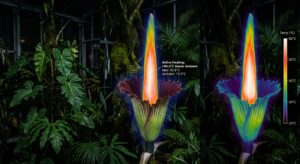
The corpse flower doesn’t rely on smell alone. During its brief blooming period, the spadix can heat up to 98°F (37°C) – roughly human body temperature. This thermogenesis serves two critical functions: it helps volatilize the stench compounds, spreading them more effectively through the air, and it mimics the warmth of a fresh corpse, making the deception even more convincing to potential pollinators.
A Giant Among Flowers
The corpse flower holds the title of having the largest unbranched inflorescence in the plant kingdom. What many people mistake for a single massive flower is actually a complex structure containing hundreds of tiny male and female flowers clustered around the base of the spadix. The dramatic burgundy spathe that surrounds this cluster can reach diameters of 3 to 4 feet, creating a cathedral-like chamber that traps and concentrates the plant’s signature scent.
The underground corm (similar to a bulb) that produces this spectacle is equally impressive. In cultivation, these can weigh over 170 pounds, though wild specimens typically range from 110 to 130 pounds. This massive energy storage allows the plant to put on its incredible show without any leaves – a truly remarkable feat in the plant world.
The Pollination Gambit
The corpse flower’s reproductive strategy is as fascinating as it is complex. The plant is protogynous, meaning the female flowers become receptive before the male flowers release their pollen. This prevents self-pollination and ensures genetic diversity. On the first night of blooming, the female flowers are ready to receive pollen from insects that have visited other corpse flowers. The male flowers don’t release their pollen until the second night, by which time the female flowers are no longer receptive.
This timing creates a narrow window for successful pollination, making it one of the most challenging reproductive strategies in the plant kingdom. Pollinators must visit multiple flowers in the correct sequence, and with blooms occurring so rarely and unpredictably, successful reproduction in the wild is remarkably uncommon.
Conservation and Cultivation Challenges
In its native Sumatra, the corpse flower faces significant threats from deforestation and habitat destruction. The plant’s specific requirements – warm, humid conditions and rich, well-draining soil – are found in increasingly fragmented forest patches. This has made conservation efforts critical for the species’ survival.
Botanical gardens around the world have become unlikely heroes in corpse flower conservation. Institutions like the Huntington Library, the New York Botanical Garden, and the University of California Botanical Garden have successfully cultivated these plants, creating breeding programs and public awareness campaigns. When a corpse flower blooms in cultivation, it often draws thousands of visitors willing to brave the stench for a glimpse of this botanical wonder.
The Cultivation Challenge
Growing a corpse flower requires patience that would test even the most dedicated gardener. Beyond the decade-long wait for blooms, the plant has specific needs:
- Temperatures between 75-85°F year-round
- High humidity (80% or higher)
- Well-draining, nutrient-rich soil
- Bright, indirect light
- A dormancy period where the corm rests without leaves
Cultural Impact and Scientific Significance
The corpse flower has captured human imagination in ways few plants have managed. Its rare blooms become media events, with botanical gardens livestreaming the process and visitors planning trips around bloom predictions. The plant has inspired art, literature, and even horror movies, cementing its place in popular culture as nature’s ultimate oddity.
From a scientific perspective, the corpse flower represents a fascinating example of evolutionary specialization. Its extreme adaptations – the massive size, the precise chemical mimicry, the thermogenesis, and the complex reproductive timing – demonstrate how evolution can produce seemingly impossible solutions to survival challenges.
Research into the corpse flower’s heat production has contributed to our understanding of thermogenic plants, while studies of its chemical compounds have applications in everything from pest control to perfume development. The plant serves as a living laboratory for understanding plant-pollinator relationships and chemical ecology.
The corpse flower stands as a testament to nature’s incredible creativity and the endless surprises our planet holds. In a world where we think we’ve seen everything, this remarkable plant reminds us that evolution still has the power to astonish, disgust, and inspire us all at once. For those brave enough to witness its rare bloom, the corpse flower offers an unforgettable encounter with one of Earth’s most extraordinary life forms.