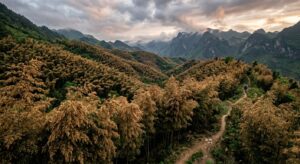
Deep in the misty highlands of Malaysian Borneo, on the slopes of Mount Kinabalu, grows one of Earth’s most exclusive botanical treasures. The black orchid, known scientifically as Coelogyne pandurata, represents the pinnacle of evolutionary specialization and natural rarity. This extraordinary flower has captured the imagination of botanists, orchid enthusiasts, and nature lovers worldwide, not just for its stunning appearance, but for its incredibly restricted habitat that spans mere square kilometers on our vast planet.
The Crown Jewel of Sabah
The black orchid holds the distinguished title of Sabah’s state flower, a designation that speaks to both its beauty and its profound connection to the region’s natural heritage. Despite its common name, the orchid isn’t entirely black. Instead, it displays deep emerald green petals with distinctive black stripes and markings, creating an otherworldly appearance that seems almost too perfect to be natural. The lip of the flower features intricate patterns that resemble abstract art, with velvety black patches contrasting against lighter green backgrounds.
What makes this orchid truly remarkable isn’t just its striking appearance, but its incredible exclusivity. While many rare plants can be found in multiple locations across continents or even countries, Coelogyne pandurata has chosen Mount Kinabalu as its sole earthly residence. This 4,095-meter peak in Malaysian Borneo provides the only conditions on Earth where this species can survive and thrive naturally.
Mount Kinabalu: A Botanical Paradise
Mount Kinabalu isn’t just any mountain. This UNESCO World Heritage site represents one of the most biodiverse places on our planet, harboring an estimated 5,000 to 6,000 plant species. The mountain’s unique geological composition, combined with its dramatic elevation changes and distinct microclimates, has created evolutionary laboratories where species like the black orchid have developed in complete isolation.
The mountain’s granite peaks, formed over millions of years, create a series of distinct ecological zones. As elevation increases, tropical rainforests give way to oak woodlands, then to rhododendron forests, and finally to alpine meadows near the summit. Each zone maintains its own temperature ranges, humidity levels, and seasonal patterns, creating a vertical archipelago of habitats.
The Perfect Storm of Conditions
The black orchid specifically inhabits the lower montane forest zone, typically found between 500 and 1,200 meters above sea level. This narrow band of elevation provides the precise combination of factors the orchid requires:
- Consistent humidity levels ranging between 80-90% year-round
- Filtered sunlight through the forest canopy, providing bright but indirect illumination
- Stable temperatures between 18-25°C (64-77°F) with minimal daily variation
- Specific host trees that provide the right bark texture and chemical environment
- Adequate air circulation preventing fungal infections while maintaining moisture
An Epiphytic Lifestyle
Like many tropical orchids, Coelogyne pandurata lives as an epiphyte, meaning it grows on other plants rather than in soil. This aerial lifestyle requires extraordinary adaptations. The orchid’s thick, waxy leaves help retain moisture in the often-windy mountain environment, while specialized aerial roots can absorb water directly from the humid air and occasional mists that shroud Mount Kinabalu.
The relationship between the black orchid and its host trees represents a delicate balance perfected over millennia. The orchid doesn’t parasitize its host but instead forms a commensal relationship, gaining support and positioning while neither helping nor harming the tree. This relationship is so specific that the orchid cannot survive on just any tree species, further limiting its potential habitat even within its already restricted range.
The Mystery of Ultra-Specialization
Scientists continue to investigate why Coelogyne pandurata has evolved to be so incredibly specialized. Most successful plant species tend to be generalists, capable of adapting to various conditions and spreading across wide geographical ranges. The black orchid represents the opposite evolutionary strategy: becoming perfectly adapted to one specific set of conditions while sacrificing the ability to survive anywhere else.
This ultra-specialization may have developed due to Mount Kinabalu’s geological isolation. As the mountain formed and reached its current height, populations of ancestral orchids became separated from their lowland relatives. Over millions of years, these isolated populations adapted specifically to their mountain environment, eventually becoming so specialized that they lost the ability to survive in their ancestral habitats.
Pollination Mysteries
The black orchid’s reproductive strategy adds another layer to its mystique. The flower produces a subtle, sweet fragrance that attracts specific insect pollinators, likely small beetles or flies that are themselves endemic to Mount Kinabalu. This co-evolution between plant and pollinator creates an intricate web of dependencies that further explains why the orchid cannot simply be transplanted to other locations, even those with seemingly similar conditions.
Conservation Challenges and Efforts
The extreme rarity and limited distribution of Coelogyne pandurata make it exceptionally vulnerable to environmental changes. Climate change poses a particular threat, as even small shifts in temperature or precipitation patterns could push conditions beyond the orchid’s narrow tolerance range. With nowhere else to retreat, the species could face extinction if its mountain habitat becomes unsuitable.
Conservation efforts focus on protecting Mount Kinabalu’s ecosystem integrity while conducting research on the orchid’s specific needs. The Sabah Parks authority, which manages Mount Kinabalu National Park, has implemented strict regulations on plant collection and habitat disturbance. Research stations on the mountain continuously monitor environmental conditions and orchid populations to track any changes that might threaten the species.
Cultivation efforts have met with mixed success. While some botanical gardens have managed to keep black orchids alive in controlled environments, replicating the exact conditions of Mount Kinabalu proves extraordinarily challenging. The orchid’s dependence on specific humidity patterns, air circulation, and possibly even unique soil microorganisms makes artificial cultivation a complex undertaking.
A Living Symbol of Earth’s Complexity
The black orchid of Borneo serves as a powerful reminder of our planet’s incredible biological diversity and the intricate relationships that exist within natural ecosystems. Its existence on a single mountain peak demonstrates how evolution can create extraordinary beauty and complexity even in the most specific circumstances. As we continue to explore and understand our world, species like Coelogyne pandurata remind us that some of nature’s most magnificent creations exist in the most unexpected and exclusive locations, waiting to inspire wonder in those fortunate enough to encounter them.