Nature’s Most Incredible Living Libraries
Deep in the world’s oldest forests stand silent witnesses to centuries of climate history. These ancient trees hold secrets that would make any time traveler jealous: they carry detailed records of every drought, flood, and climate catastrophe that occurred during their lifespans. Some of these wooden chronometers have been faithfully recording environmental data for over 400 years, creating the most accurate natural archives of our planet’s climate history.
What makes this phenomenon even more mind-blowing is that trees don’t just remember these events passively. They actively encode this information into their very structure, creating a biological hard drive that scientists are only now learning to read with stunning precision.
The Secret Language Written in Wood
Every year, trees add a new ring to their trunk. But these aren’t just simple circles of growth. Each ring is like a detailed diary entry, packed with information about the weather, water availability, temperature fluctuations, and even catastrophic events that occurred during that specific year.
When a tree experiences drought, it doesn’t just suffer quietly. The lack of water forces the tree to create smaller cells with thicker walls, resulting in denser wood that looks distinctly different from rings formed during wet years. These drought rings are often noticeably thinner and darker than their well-watered counterparts.
How Trees Encode Climate Data
The process is fascinatingly complex. During drought years, several things happen simultaneously:
- Cell size shrinks: Water-stressed trees produce smaller xylem cells, the tubes that transport water and nutrients
- Wall thickness increases: The cell walls become notably thicker as the tree concentrates its resources
- Growth rate plummets: Less water means less photosynthesis, resulting in dramatically reduced growth
- Chemical composition changes: The tree alters its chemical makeup, creating isotopic signatures that scientists can detect centuries later
Ancient Forests as Climate Detectives
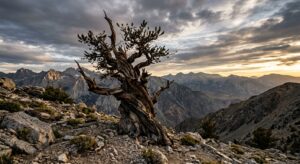
Some of the most remarkable climate records come from trees that have witnessed centuries of human history. Bristlecone pines in California’s White Mountains have been growing for over 4,000 years, making them older than the Egyptian pyramids. European oaks can live for 800-1,000 years, while some Douglas firs in the Pacific Northwest have been steadily growing for more than 700 years.
These ancient giants have recorded every major drought in their regions with startling accuracy. Scientists studying oak trees in Central Europe discovered that they could identify specific drought years from the 1600s and 1700s that matched perfectly with historical records of crop failures and famines.
Decoding the Messages
Modern dendrochronology uses sophisticated techniques to extract climate data from tree rings:
- Core sampling: Scientists extract thin cores from living trees without harming them
- Cross-dating: Patterns are matched across multiple trees to verify accuracy
- Isotope analysis: Chemical signatures reveal temperature and precipitation data
- Cell measurement: Microscopic analysis reveals stress patterns invisible to the naked eye
Shocking Revelations from Tree Ring Archives
The information hidden in these wooden time capsules has revealed some truly astonishing facts about our planet’s climate history. Tree ring data has uncovered “megadroughts” that lasted for decades in the American Southwest, helping scientists understand that our recent climate patterns are actually quite mild compared to historical extremes.
Perhaps most surprisingly, trees from the same forest can show dramatically different responses to the same drought, revealing the complex microclimates that exist even within small areas. Some trees, growing just meters apart, might show severe drought stress while others appear relatively unaffected, teaching us that nature’s responses to climate are far more nuanced than we previously understood.
The Medieval Climate Anomaly Revealed
Tree rings have provided crucial evidence for the Medieval Warm Period (roughly 950-1250 CE) and the subsequent Little Ice Age (1300-1850 CE). Ancient trees show that these climate shifts were far more dramatic and regionally variable than historical documents alone could reveal.
Modern Implications of Ancient Memories
Understanding how trees recorded and survived past droughts is becoming increasingly critical as our planet faces new climate challenges. These biological archives provide invaluable baselines for understanding normal climate variability versus unprecedented change.
Scientists are now using 400-year-old drought records to improve modern climate models and predict future water availability. The trees are essentially providing us with a crystal ball, showing us how forests might respond to future droughts based on their documented survival strategies from centuries past.
Conservation Urgency
As climate change accelerates, protecting these ancient forest libraries becomes even more crucial. Each old-growth tree that falls to logging or development takes with it centuries of irreplaceable climate data. Some scientists argue that ancient trees should be considered as valuable as any historical artifact, deserving protection not just for their ecological importance but for their role as living climate databases.
The Future Written in Ancient Wood
Perhaps the most incredible aspect of this natural phenomenon is that it’s still happening. Right now, trees around the world are encoding information about our current climate crisis into their rings. Future scientists will be able to read the story of 21st-century climate change written in the wood of trees that are growing today.
These silent forest dwellers remind us that nature has been keeping meticulous records long before humans invented writing. In their rings lie not just memories of past droughts, but lessons about resilience, adaptation, and survival that could prove invaluable as we face an uncertain climatic future.