Deep within the world’s darkest forests, something magical happens when the sun goes down. While most life retreats into the shadows, certain mysterious organisms begin their nightly light show. These aren’t fireflies or glowworms, but something far stranger: mushrooms that produce their own ethereal green light, transforming woodland floors into scenes straight from a science fiction movie.
The Phenomenon That Baffled Scientists for Centuries
Bioluminescent mushrooms have puzzled humans since ancient times. Greek philosopher Aristotle wrote about strange glowing wood as early as 382 BCE, describing timber that seemed to harbor trapped starlight. For centuries, people attributed these glowing fungi to supernatural forces, magic, or divine intervention. It wasn’t until modern science caught up that we began to understand the incredible biochemistry behind nature’s own lighting system.
Today, we know that approximately 80 species of fungi worldwide possess the ability to produce their own light. These remarkable organisms belong to various families, but they all share one extraordinary trait: they can convert chemical energy into visible light through a process called bioluminescence, creating an otherworldly green glow that can illuminate entire forest sections on the darkest nights.
The Science Behind the Glow
The mechanism that allows mushrooms to glow involves a fascinating chemical reaction that occurs within their tissues. Here’s how nature’s lighting system works:
The Biochemical Light Factory
Bioluminescent mushrooms produce light through a reaction involving a compound called luciferin and an enzyme called luciferase. When oxygen enters the equation, these components interact to create light energy. The process is remarkably similar to how fireflies create their glow, though mushrooms have evolved this ability independently.
What makes fungal bioluminescence particularly intriguing is its efficiency. Unlike incandescent bulbs that waste most energy as heat, mushrooms convert nearly 100% of the chemical energy into light. This biological LED system produces virtually no heat, making it one of nature’s most efficient lighting mechanisms.
The Green Light Mystery
Most bioluminescent mushrooms emit light in the green spectrum, typically around 520-530 nanometers wavelength. This specific color isn’t random. Green light travels well through forest environments and is highly visible to many insects and small animals that might help disperse the mushroom’s spores.
Meet the Glowing Mushroom Species
Several species of bioluminescent fungi create spectacular displays across different continents:
Panellus stipticus: The Common Glow
Found throughout North America and parts of Asia, Panellus stipticus is one of the most widespread bioluminescent mushrooms. These small, fan-shaped fungi grow on decaying hardwood and produce a soft green glow visible to the naked eye in complete darkness. Interestingly, only certain populations glow, with North American specimens being more luminescent than their European counterparts.
Armillaria mellea: The Honey Mushroom Horror
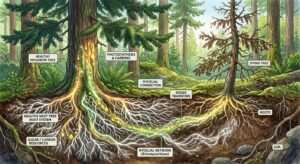
While beautiful to observe, the glowing honey mushroom represents nature’s darker side. This parasitic species attacks living trees and can create vast underground networks spanning thousands of acres. When conditions are right, infected wood glows with an eerie green light, earning it the nickname “foxfire” in folklore.
Mycena chlorophos: The Tropical Star
Native to tropical regions of Asia, Mycena chlorophos creates some of the most intense bioluminescent displays in the fungal kingdom. These tiny mushrooms, no larger than a fingernail, can produce light bright enough to read by. They typically fruit during rainy seasons, creating magical scenes in tropical forests.
Why Do Mushrooms Glow?
The evolutionary purpose behind fungal bioluminescence has sparked intense scientific debate. Several theories attempt to explain why mushrooms would invest precious energy into producing light:
The Attraction Hypothesis
Many scientists believe bioluminescence serves as a beacon to attract insects and other small creatures. These visitors might inadvertently pick up spores on their bodies, helping the fungi reproduce by carrying genetic material to new locations. The green light acts like a neon sign advertising the mushroom’s presence to potential spore dispersers.
The Defense Theory
Some researchers propose that the light serves a protective function. The glow might startle or confuse potential predators, giving the mushroom a survival advantage. Alternatively, the light could signal that the mushroom is toxic or unpalatable, warning animals to stay away.
The Metabolic Byproduct Idea
A third theory suggests that bioluminescence might simply be a byproduct of the mushroom’s metabolism rather than serving any specific purpose. The light could be an accidental result of biochemical processes necessary for the fungus’s survival and growth.
Where to Witness the Magic
Bioluminescent mushrooms can be found on every continent except Antarctica, but some locations offer particularly spectacular displays:
- Olympic National Forest, Washington: Home to diverse bioluminescent species growing on fallen logs
- Brazilian Atlantic Forest: Features intense displays of glowing Mycena species
- Japanese Forests: Host numerous bioluminescent varieties, particularly during humid summer months
- Australian Rainforests: Showcase unique endemic glowing species
The Future of Glowing Fungi
Scientists are now exploring practical applications for fungal bioluminescence. Researchers have successfully transferred bioluminescent genes from mushrooms into other organisms, creating glowing plants and bacteria. This technology could lead to sustainable biological lighting systems, reducing our dependence on electricity for illumination.
Additionally, understanding how mushrooms create light so efficiently could inspire new developments in LED technology and energy conservation. The study of bioluminescent fungi continues to reveal secrets that might revolutionize how we think about lighting and energy use.
Conservation Concerns
As forests worldwide face increasing pressure from deforestation and climate change, many bioluminescent mushroom populations are declining. These fungi often depend on specific environmental conditions and host trees, making them particularly vulnerable to habitat destruction. Protecting the forests where these magical organisms live ensures future generations will witness nature’s incredible light show.
The next time you find yourself in a dark forest, remember that beneath your feet and around fallen logs, nature’s own lanterns might be glowing softly in the darkness, creating one of Earth’s most enchanting and mysterious spectacles.