While families gather beneath mistletoe for holiday kisses, few realize they’re standing under nature’s most charming vampire. That innocent sprig of festive greenery hiding above your doorway is actually a sophisticated biological hijacker that has spent millions of years perfecting the art of tree theft.
Mistletoe isn’t just growing on trees, it’s actively stealing from them. This parasitic plant has evolved into one of nature’s most cunning criminals, developing specialized weapons to penetrate bark, hijack water supplies, and slowly drain the life from its hosts. The cheerful holiday symbol we know and love is actually engaged in a silent war happening right above our heads.
The Anatomy of a Plant Vampire
Unlike typical plants that politely gather nutrients from soil through their roots, mistletoe has abandoned conventional plant behavior entirely. Instead, it has evolved specialized structures called haustoria, which function like biological syringes. These modified roots don’t dig down into earth, they dig sideways into living wood.
When a mistletoe seed lands on a tree branch, it doesn’t waste time with pleasantries. The seed immediately begins producing a sticky holdfast that cements it to the bark surface. From there, it deploys its haustorium, a penetrating organ that works like a living drill bit, boring through the protective bark layer.
What happens next is both fascinating and terrifying from the tree’s perspective. The haustorium doesn’t stop at the bark, it continues drilling until it reaches the tree’s xylem, the network of tubes that carry water and nutrients from roots to leaves. Once connected, mistletoe essentially becomes part of the tree’s circulatory system, siphoning off water and dissolved minerals for its own use.
Masters of Hydraulic Theft
The most diabolical aspect of mistletoe’s strategy lies in its control over water movement. Trees carefully regulate their water transport through complex hydraulic systems, but mistletoe disrupts this delicate balance. Research has shown that mistletoe can actually influence the water potential of its host branch, creating a hydraulic gradient that favors the parasite.
Dr. David Watson, a mistletoe researcher at Charles Sturt University, discovered that mistletoe doesn’t just passively receive water from its host. The parasite actively manipulates the host’s water transport system, essentially hijacking the tree’s plumbing to redirect resources toward the infection site.
This hydraulic manipulation has cascading effects throughout the infected branch. The area around a mistletoe infection often shows altered growth patterns, with the parasite effectively rewiring the tree’s resource allocation. It’s like a biological hacker gaining admin access to the tree’s operating system.
The Water Wars
The battle for water becomes especially intense during drought conditions. While the host tree struggles to conserve moisture, mistletoe continues its relentless extraction. Studies have documented cases where heavily infected trees show signs of water stress even when soil moisture levels remain adequate for healthy trees.
Some species of mistletoe have evolved to be particularly aggressive water thieves. The dwarf mistletoe species that plague coniferous forests can extract such massive quantities of water that they create visible swellings called witches’ brooms, where the host tree’s growth becomes completely distorted around the infection site.
Chemical Warfare and Host Manipulation
Water theft is just the beginning of mistletoe’s arsenal. These parasitic plants also engage in sophisticated chemical warfare, releasing hormones and growth regulators that manipulate their hosts’ behavior. Research has identified several ways mistletoe chemically controls its victims:
- Growth hormone manipulation: Mistletoe releases auxin-like compounds that alter the host’s growth patterns, often causing abnormal branching around infection sites
- Defense suppression: The parasite produces chemicals that suppress the tree’s natural immune responses, preventing the host from sealing off the infection
- Nutrient redirection: Mistletoe influences the host’s metabolism to increase nutrient flow toward the infection site
- Phenological manipulation: Some mistletoe species can alter their host’s seasonal timing, affecting when the tree produces leaves or flowers
The Evolutionary Arms Race
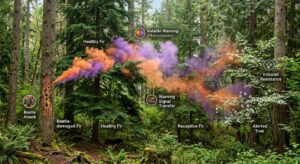
This parasitic relationship has been evolving for millions of years, creating an ongoing evolutionary arms race between mistletoe and its hosts. Trees have developed various defense mechanisms, including compartmentalization strategies that attempt to isolate infections and specialized bark compounds that resist haustorium penetration.
However, mistletoe has proven remarkably adaptable. Different species have evolved specialized strategies for different host trees. Some mistletoes target specific tree species, while others are generalists that can parasitize dozens of different hosts. The European mistletoe (Viscum album) that adorns our holiday celebrations primarily targets apple trees, poplars, and other deciduous species, while its relatives have specialized for everything from cacti to massive forest trees.
Global Impact
The impact of these plant vampires extends far beyond individual trees. In some ecosystems, mistletoe infections affect forest dynamics on a landscape scale. Heavy mistletoe loads can make trees more susceptible to drought, wind damage, and other stresses. Forest managers in places like the southwestern United States spend millions of dollars annually managing dwarf mistletoe infections that can devastate coniferous forests.
Yet mistletoe also plays important ecological roles. The dense clumps of parasitic growth provide nesting sites for birds, and mistletoe berries are crucial winter food sources for many wildlife species. This creates a complex ecological web where the same organism that weakens forest trees also supports forest biodiversity.
The Holiday Parasite’s Dark Secrets
The next time you find yourself beneath the mistletoe, take a moment to appreciate the sophisticated biological warfare happening just inches above your head. That innocent-looking sprig represents millions of years of evolutionary refinement in the art of tree hijacking. Its waxy leaves are fed by stolen water, its berries nourished by pilfered nutrients, and its very existence depends on its ability to manipulate and control its living host.
Perhaps there’s something poetically appropriate about hanging a parasite above our doorways during the season of giving. Mistletoe reminds us that nature is far more complex and morally ambiguous than our holiday decorations might suggest. In the natural world, even the most charming appearances can hide the most sophisticated criminal enterprises.
So this holiday season, as you share kisses beneath the mistletoe, remember that you’re celebrating under one of nature’s most successful biological pirates. It’s a fitting symbol for a species that has mastered the art of taking what it needs to survive, regardless of the cost to others.