The Ocean’s Tiniest Sonic Weapon
Deep beneath the waves, a creature no bigger than your thumb produces one of the loudest sounds on Earth. The pistol shrimp, also known as the snapping shrimp, can generate acoustic blasts that reach 218 decibels, louder than a gunshot and rivaling the noise levels of jet engines during takeoff. But sound is just the beginning of this crustacean’s incredible story.
What makes this discovery even more astounding is that these tiny marine animals accomplish this feat using nothing more than a specialized claw. No vocal cords, no air-filled chambers, just pure biomechanical engineering that puts human technology to shame.
The Science Behind the Snap
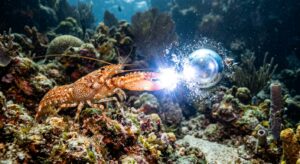
The pistol shrimp’s secret weapon lies in its asymmetrical claws. One claw develops into an oversized appendage with a unique structure that functions like a biological gun. When the shrimp rapidly closes this claw, it creates a high-speed water jet that forms cavitation bubbles.
These bubbles collapse almost instantaneously, producing the characteristic loud snap. But here’s where things get truly mind-blowing: the collapsing bubbles generate temperatures that can reach 4,700 degrees Celsius (8,492 degrees Fahrenheit). That’s nearly as hot as the surface of the sun, which sits at about 5,500 degrees Celsius.
The Physics of Cavitation
The phenomenon responsible for the pistol shrimp’s incredible abilities is called cavitation. When the shrimp snaps its claw shut at lightning speed, it shoots a jet of water so fast that it creates areas of extremely low pressure behind it. These low-pressure zones cause water to vaporize instantly, forming bubbles.
When these bubbles collapse, they release enormous amounts of energy in an incredibly small space and timeframe. The process happens so quickly that it generates:
- Sound waves reaching up to 218 decibels
- Temperatures approaching those found on the sun’s surface
- Light flashes visible to sensitive equipment
- Shock waves powerful enough to stun or kill prey
Hunting with Sonic Booms
The pistol shrimp doesn’t create these incredible forces just for show. This biological weapon serves as their primary hunting tool. When small fish, crabs, or other prey venture too close, the shrimp aims its specialized claw and fires.
The shock wave from the cavitation bubble is powerful enough to stun or even kill prey instantly. Fish caught in the blast become disoriented and easy targets for the shrimp to capture with its other, more conventionally-shaped claw.
Some species of pistol shrimp can accurately hit targets up to 4 centimeters away, which might not sound impressive until you consider that’s roughly twice their body length. Imagine a human accurately throwing a knockout punch at a target 12 feet away using only the shock wave from their fist.
Communication Through Chaos
Beyond hunting, pistol shrimp also use their snapping abilities for communication. Different species have developed distinct snapping patterns and rhythms that help them identify potential mates, warn off rivals, and establish territorial boundaries.
Marine biologists have discovered that some pistol shrimp communities create such a cacophony of snapping that they can interfere with sonar equipment and underwater communication systems. During World War II, submarine crews learned to hide near pistol shrimp colonies because the constant snapping would mask their sonar signatures from enemy detection.
Evolutionary Mastery
What makes the pistol shrimp’s abilities even more remarkable is how they evolved this incredible mechanism. Unlike many extreme adaptations that take millions of years to develop, the pistol shrimp’s snapping claw can regenerate if lost.
Even more fascinating, if a pistol shrimp loses its large snapping claw, the smaller claw will grow to replace it, while a new small claw grows where the large one used to be. This regenerative ability suggests that the genetic instructions for creating this biological weapon are remarkably robust and flexible.
Diverse Species, Similar Solutions
There are over 600 species of pistol shrimp found in tropical and subtropical waters around the world. While they all share the basic snapping mechanism, different species have evolved unique variations:
- Some species have developed enhanced accuracy for precision hunting
- Others create louder snaps for long-distance communication
- Certain species can produce rapid-fire sequences of snaps
- Some have evolved cooperative hunting strategies with other marine animals
Implications for Human Technology
Scientists and engineers are studying pistol shrimp to understand how such efficient energy transfer and cavitation control might be applied to human technology. The shrimp’s ability to create controlled cavitation could inspire new approaches to:
- Underwater propulsion systems
- Sonic cleaning technologies
- Medical applications using focused shock waves
- Materials processing techniques
The pistol shrimp proves once again that nature’s solutions often surpass human engineering in elegance and efficiency.
A Living Reminder of Ocean Mysteries
The next time you hear about the loudest sounds on Earth, remember that somewhere in the ocean depths, creatures smaller than your finger are creating sonic booms that would make jet engines jealous. The pistol shrimp serves as a perfect reminder that our planet’s most incredible phenomena often come in the smallest packages.
These remarkable crustaceans continue to surprise researchers with their abilities, proving that there’s still so much we don’t know about the life thriving in our oceans. In a world where we’re constantly amazed by human technological achievements, the pistol shrimp stands as a testament to the fact that nature got there first, and often did it better.