
In the murky waters of the Amazon basin, one of nature’s most sophisticated predators lurks beneath the surface. The electric eel doesn’t just shock its prey into submission: it literally takes control of their muscles, turning them into unwilling puppets in a deadly game of remote control.
This incredible biological phenomenon represents one of the most advanced hunting strategies in the animal kingdom, where bioelectricity becomes a weapon of neurological warfare.
The Master of Bioelectric Control
Despite its name, the electric eel (Electrophorus electricus) isn’t actually an eel at all. This remarkable fish is more closely related to catfish and belongs to a group called knifefish. What makes it truly extraordinary is its ability to generate electrical discharges of up to 860 volts, enough to power a household appliance or stop a human heart.
But recent scientific discoveries have revealed that electric eels don’t simply use their electrical abilities as a taser-like weapon. Instead, they’ve evolved into biological puppet masters, capable of remotely controlling the neuromuscular systems of their prey with surgical precision.
The Science Behind the Remote Control
The electric eel’s body is essentially a living battery, with specialized cells called electrocytes that can generate and discharge electricity on command. These cells make up about 80% of the eel’s body mass and are arranged in series like the cells in a battery pack.
When hunting, the eel employs three distinct types of electrical discharges:
- Low-voltage pulses: Used for navigation and detecting prey in murky water
- Medium-voltage bursts: Designed to remotely activate prey muscles
- High-voltage attacks: The final devastating blow that immobilizes the victim
The medium-voltage bursts are where the true genius of this predator becomes apparent. These carefully calibrated electrical pulses are designed to mimic the natural electrical signals that the prey’s own nervous system uses to control muscle movement.
Hijacking the Nervous System
When an electric eel detects potential prey hiding nearby, it releases a series of medium-voltage electrical pulses into the water. These pulses travel through the conductive medium and penetrate the prey’s body, where they interact directly with the motor neurons that control muscle movement.
The eel’s electrical field effectively overrides the prey’s nervous system, causing involuntary muscle contractions. This forced movement serves multiple purposes: it reveals the exact location of hidden prey, causes the victim to lose its concealment, and often forces the prey to swim directly toward the predator.
Imagine trying to hide from a predator, only to have your own muscles betray you, forcing you to reveal your position and swim toward certain death. This is the terrifying reality for fish that encounter an electric eel.
The Three-Phase Attack Strategy
Electric eels have perfected a three-phase hunting strategy that demonstrates remarkable sophistication:
Phase 1: Detection and Remote Activation
Using low-voltage electrical fields, the eel scans its environment like a biological radar system. Once prey is detected, the eel switches to medium-voltage pulses that cause the hidden prey’s muscles to contract involuntarily, revealing their location through movement.
Phase 2: Forced Approach
The eel continues to send remote control signals that hijack the prey’s swimming muscles. These electrical commands can actually force the victim to swim toward the predator, similar to how a video game player controls a character’s movements.
Phase 3: The Killing Blow
Once the prey is within striking distance, the eel delivers a massive high-voltage discharge that overwhelms the victim’s nervous system entirely, causing complete muscular paralysis or death.
Evolutionary Perfection
This remote control ability represents millions of years of evolutionary refinement. The electric eel has essentially evolved into a biological hacker, capable of breaking into and commandeering the nervous systems of other creatures.
The precision required for this type of neural manipulation is staggering. The eel must generate electrical pulses at exactly the right frequency, voltage, and duration to mimic natural nerve signals without immediately killing the prey. Too little electricity, and the remote control fails. Too much, and the prey dies before it can be manipulated.
Beyond Science Fiction
The electric eel’s abilities seem like something from a science fiction movie, yet they represent very real evolutionary adaptations. These creatures have effectively solved the problem of prey detection and capture in one of the world’s most challenging aquatic environments.
The muddy, vegetation-choked waters of the Amazon provide countless hiding places for potential prey. Visual hunting becomes nearly impossible in these conditions, so the electric eel evolved to use bioelectricity not just as a weapon, but as a sophisticated sensory and control system.
Research and Implications
Scientists studying electric eels have made groundbreaking discoveries about bioelectricity and its potential applications. Understanding how these creatures generate and control electrical fields has inspired research into:
- Bio-inspired electrical systems
- Advanced medical devices
- Underwater robotics and navigation systems
- Neural interface technologies
The electric eel’s remote control abilities also provide insights into how nervous systems work and how electrical signals can be used to manipulate biological functions.
A Living Marvel
The electric eel stands as one of nature’s most remarkable predators, having evolved capabilities that blur the line between biology and technology. Its ability to remotely control the muscles of other creatures represents a level of biological sophistication that continues to amaze researchers and nature enthusiasts alike.
In the dark waters of the Amazon, these living batteries continue their ancient dance of electrical predation, serving as a reminder that the natural world still holds secrets that can inspire and astound us. The electric eel doesn’t just hunt its prey; it turns them into unwilling accomplices in their own capture, making it one of the most formidable and fascinating predators on our planet.



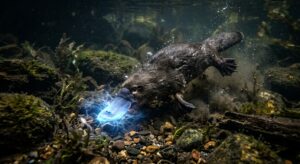


ok so this is wild but now im wondering if theres anything similar happening in the savanna context, like do any of the predators there have anything close to this level of neurological manipulation over prey? ive spent so much time reading about lion hunting strategies and hyena pack tactics but its all pretty straightforward compared to literally hijacking a nervous system lol. the eels are basically playing 4d chess while lions are just running down wildebeest, which makes you appreciate how many different ways evolution figured out to be absolutely brutal
Log in or register to replyThis is such a great example of why I drag people to the museum’s aquatics hall, because once you see the setup of those organs and understand the voltage gradients involved, the whole predation strategy clicks into place in a way that just feels… inevitable? The “puppet master” framing is catchy but I’d argue it undersells how elegant the physics actually is, since they’re essentially using their prey’s own ion channels against them rather than anything truly remote in the sci-fi sense. Still mind-bending stuff though.
Log in or register to replyYeah, you’re hitting on something important – the “hijacking” language is definitely clickbait compared to what’s actually happening, which is exploiting basic electrophysiology that’s been around since fish first evolved nervous systems. The elegance is in the precision and iterative refinement over millions of years, not really in anything exotic or remote, and honestly that’s somehow *more* impressive to me than the sci-fi version would be anyway.
Log in or register to reply