Meet Earth’s Most Explosive Insect
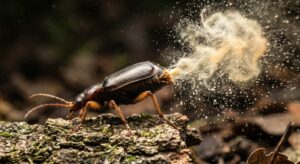
In the world of natural weaponry, few creatures can match the sheer audacity of the bombardier beetle. This unassuming insect, typically no larger than a paper clip, carries within its body one of the most sophisticated and deadly defense systems found anywhere in nature. When threatened, this living flamethrower can unleash a scalding chemical spray reaching temperatures of 500°F (260°C) with pinpoint accuracy in virtually any direction.
What makes the bombardier beetle truly extraordinary isn’t just the raw power of its chemical arsenal, but the incredible engineering that allows it to aim this biological weapon with surgical precision. This remarkable ability has captivated scientists for decades and continues to inspire innovations in everything from military technology to medical devices.
The Science Behind the Explosion
The bombardier beetle’s defensive system operates like a miniature chemical plant housed within its abdomen. This biological factory consists of two separate storage chambers, each containing different chemical compounds that, when mixed, create an explosive reaction.
The first chamber stores a mixture of hydroquinones and hydrogen peroxide in an aqueous solution. The second chamber contains enzymes called catalases and peroxidases. Under normal circumstances, these chemicals remain safely separated, posing no danger to the beetle itself.
When danger strikes, the beetle’s nervous system triggers a rapid sequence of events. Muscles contract to force the contents of both chambers into a mixing chamber called the reaction chamber. Here, the enzymes catalyze the breakdown of hydrogen peroxide, releasing oxygen gas and heat. Simultaneously, the hydroquinones are oxidized into quinones, creating a toxic, boiling cocktail.
The Mechanics of Chemical Warfare
The reaction occurs so rapidly and violently that it creates immense pressure within the beetle’s body. This pressure forces the superheated mixture through a hardened nozzle called the pygidial gland opening. The entire process, from threat detection to chemical discharge, takes mere milliseconds.
What emerges is a jet of toxic quinones at near-boiling temperatures, capable of causing severe burns and chemical damage to any attacker. The spray can reach distances of up to 8 inches (20 centimeters), which is remarkably far considering the beetle’s small size.
Precision Targeting: Nature’s Artillery System
Perhaps the most impressive aspect of the bombardier beetle’s defense system is its ability to aim the chemical spray with extraordinary precision. The beetle can rotate its abdomen and adjust the angle of its pygidial glands to direct the spray toward threats approaching from almost any direction, including over its own back.
This targeting capability is made possible by a flexible abdominal structure and highly mobile pygidial glands. The beetle can bend its abdomen in ways that would be impossible for most insects, allowing it to fire at predators attacking from behind, above, or from the sides. High-speed photography has revealed that the beetle can make real-time adjustments to its aim, tracking moving targets and compensating for their movement.
The Art of Chemical Warfare
Researchers have documented bombardier beetles successfully defending themselves against a variety of predators, including ants, spiders, frogs, and even birds. The beetle’s ability to deliver multiple shots in rapid succession makes it a formidable opponent despite its small size. Each beetle can fire approximately 20 to 30 shots before depleting its chemical reserves.
The spray isn’t just hot and toxic; it also serves as a smoke screen. The rapid vaporization of water in the superheated mixture creates a visible cloud that can confuse and disorient attackers, giving the beetle precious seconds to escape.
Evolutionary Marvel
The bombardier beetle’s chemical defense system represents one of evolution’s most sophisticated engineering solutions. Scientists believe this complex mechanism evolved gradually over millions of years, with each component building upon previous adaptations.
The precision aiming capability likely evolved as predators became more sophisticated in their hunting strategies. Early bombardier beetles may have only been able to spray in a fixed direction, but those with greater flexibility and accuracy had significant survival advantages.
Inspiring Human Innovation
The bombardier beetle’s remarkable abilities have not gone unnoticed by human engineers and inventors. Researchers have studied the beetle’s chemical reaction system to develop more efficient propulsion systems and fire suppression technologies.
The beetle’s ability to create controlled explosions without damaging itself has particular relevance for developing safer chemical processing systems. Additionally, the precision targeting mechanism has inspired innovations in micro-robotics and automated defense systems.
Conservation and Habitat
Bombardier beetles can be found on every continent except Antarctica, with over 500 species identified worldwide. They typically inhabit areas with loose soil or rocky crevices where they can hide during the day, emerging at night to hunt for other insects.
Despite their formidable defenses, bombardier beetles face threats from habitat destruction and environmental changes. Their complex life cycles and specific habitat requirements make them vulnerable to ecosystem disruption.
The Ultimate Survival Strategy
The bombardier beetle stands as a testament to nature’s incredible ingenuity in the eternal arms race between predator and prey. Its ability to aim a chemical spray in any direction represents millions of years of evolutionary refinement, resulting in one of the most effective defense mechanisms in the animal kingdom.
This tiny warrior continues to fascinate scientists and nature enthusiasts alike, reminding us that some of the most extraordinary innovations on our planet come in the smallest packages. The next time you encounter one of these remarkable beetles, remember that you’re looking at nature’s own precision-guided chemical weapon system, a living testament to the incredible diversity and ingenuity of life on Earth.