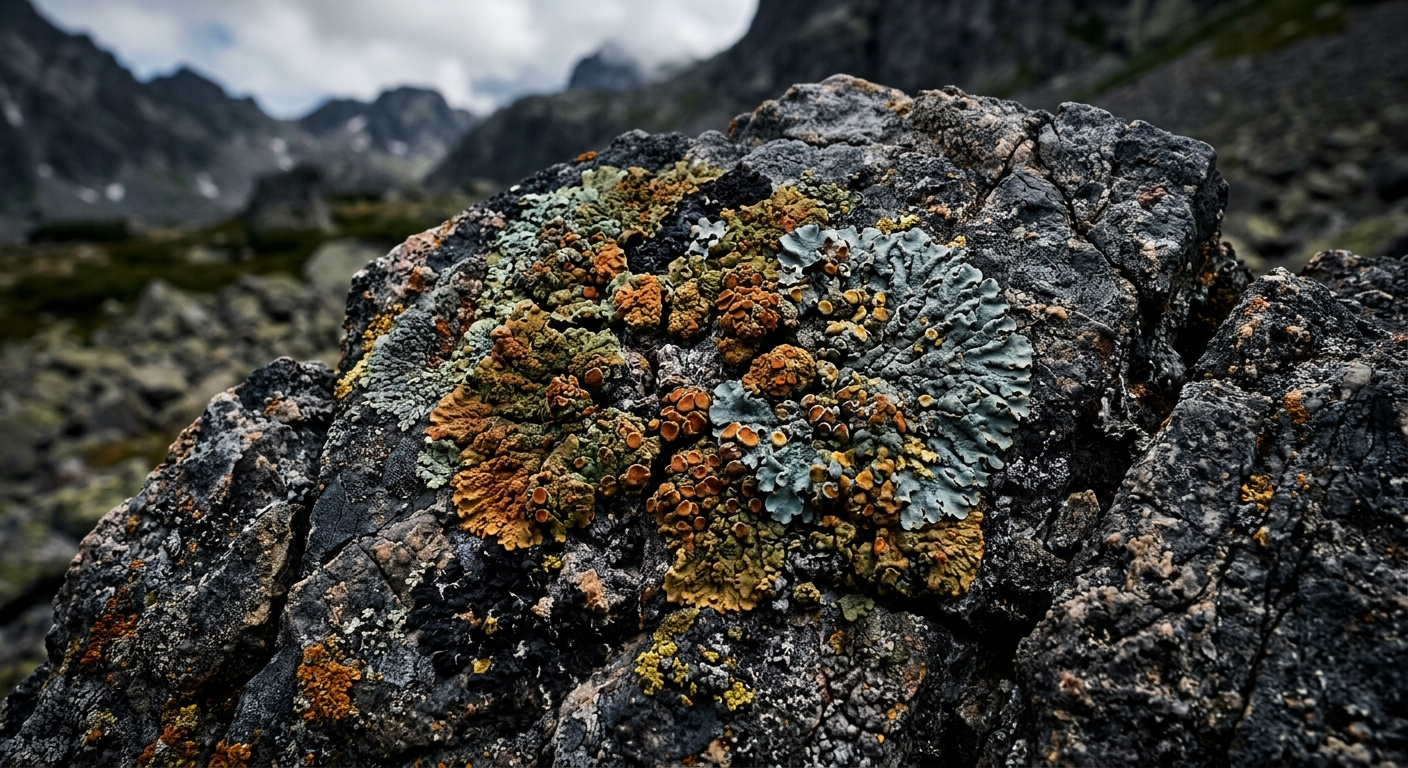
Imagine walking through a remote mountain landscape and spotting a colorful, crusty patch growing on a boulder. You might dismiss it as mere moss or algae, but what if I told you that this seemingly insignificant organism could be older than human civilization itself? Some lichens are so remarkably slow-growing that the patches we see today began their patient journey through time before the first pyramid was erected in ancient Egypt.
The Incredible Slow Lane of Lichen Growth
Lichens represent one of nature’s most extraordinary partnerships: a symbiotic relationship between fungi and algae (or cyanobacteria) that creates an organism capable of surviving in some of Earth’s harshest environments. But their superpower isn’t just survival, it’s their incredible longevity achieved through almost impossibly slow growth rates.
While most plants and fungi we’re familiar with grow measurably from season to season, many lichen species grow at rates so slow they’re measured in fractions of millimeters per year. Some of the slowest-growing crustose lichens expand their borders by as little as 0.01 to 0.1 millimeters annually. At this rate, a lichen patch just 10 centimeters across could represent thousands of years of patient, methodical growth.
Ancient Patches Hiding in Plain Sight
In Arctic and alpine environments around the world, researchers have discovered lichen colonies that predate recorded human history. The yellow map lichen (Rhizocarpon geographicum), commonly found on rocks in cold regions, has been documented with specimens estimated to be over 8,000 years old. Some researchers believe certain Antarctic lichen colonies could be even older, potentially reaching ages of 10,000 years or more.
To put this in perspective, when these ancient lichens first began growing:
- The Great Pyramid of Giza wouldn’t be built for another 4,000 years
- Stonehenge was still 3,000 years in the future
- Agriculture was just beginning to develop in some parts of the world
- Humans were still learning to work with metals
- The oldest known writing systems were yet to be invented
The Science Behind Extreme Longevity
How do lichens achieve such remarkable longevity? The secret lies in their unique biology and survival strategy. Unlike higher plants that must constantly grow and reproduce to survive, lichens have mastered the art of patience.
Metabolic Minimalism
Lichens operate on an extremely low metabolic rate. They can enter states of dormancy during unfavorable conditions, essentially putting their biological processes on hold. During dry periods, they become completely desiccated and metabolically inactive, only resuming growth when moisture returns. This stop-and-start lifestyle allows them to conserve energy and avoid the cellular damage that accumulates in faster-growing organisms.
Environmental Adaptation
The slowest-growing, longest-lived lichens are typically found in harsh environments where growing seasons are extremely short. In Arctic conditions, a lichen might only be metabolically active for a few weeks each year when temperatures rise above freezing and sufficient moisture is available. The rest of the time, they remain in suspended animation.
Cellular Resilience
Lichens have evolved remarkable resistance to radiation, extreme temperatures, and chemical stress. Some species can survive being completely frozen, dried out, or exposed to intense UV radiation that would kill most other organisms. This resilience allows them to persist through environmental changes that would eliminate faster-growing competitors.
Dating the Undatable: How Scientists Measure Lichen Age
Determining the age of these ancient organisms presents unique challenges. Unlike trees with their convenient growth rings, lichens don’t leave clear annual markers. Scientists have developed several ingenious methods to estimate lichen ages:
Lichenometry
This technique involves measuring the diameter of the largest lichen thallus (the main body) on a surface of known age, such as a tombstone or building foundation. By establishing growth rates for local conditions, researchers can then estimate the ages of lichens in similar environments.
Radiocarbon Dating
For very old specimens, scientists can use radiocarbon dating on the underlying substrate or associated organic materials. While this doesn’t directly date the lichen, it can provide minimum age estimates.
Growth Rate Studies
Long-term monitoring of marked lichen populations allows researchers to establish baseline growth rates for different species under various environmental conditions. These studies, some spanning decades, provide crucial data for age estimation models.
Ancient Witnesses to Environmental Change
These extraordinarily long-lived organisms serve as living libraries of environmental history. Because lichens are highly sensitive to air pollution and climate conditions, their presence, absence, and condition can reveal information about environmental changes spanning millennia.
Scientists studying ancient lichen colonies can potentially reconstruct historical climate patterns, pollution events, and ecosystem changes that occurred long before humans began keeping environmental records. Some researchers refer to the oldest lichens as “silent witnesses” to Earth’s environmental history.
Conservation Challenges for Earth’s Oldest Life Forms
The extreme slow growth of lichens makes them particularly vulnerable to human disturbance. A single careless footstep can destroy decades or even centuries of growth. Climate change poses an additional threat, as these organisms are highly adapted to specific temperature and moisture regimes.
In some regions, researchers are working to identify and protect the oldest lichen colonies, recognizing them as irreplaceable biological monuments. The loss of a 5,000-year-old lichen patch represents not just the death of an organism, but the erasure of millennia of environmental history.
A New Perspective on Time and Life
The next time you encounter what appears to be a simple patch of colorful crust on a rock, take a moment to consider the possibility that you might be looking at one of Earth’s oldest living residents. These humble organisms remind us that life operates on timescales far beyond human experience, and that some of the planet’s most remarkable achievements happen not through dramatic bursts of activity, but through the quiet persistence of countless tiny moments accumulated across vast stretches of time.
In our fast-paced world, lichens offer a profound lesson in patience, resilience, and the power of slow, steady progress. They’ve witnessed the rise and fall of civilizations while quietly growing, one microscopic increment at a time, reminding us that sometimes the most extraordinary achievements are also the most humble.