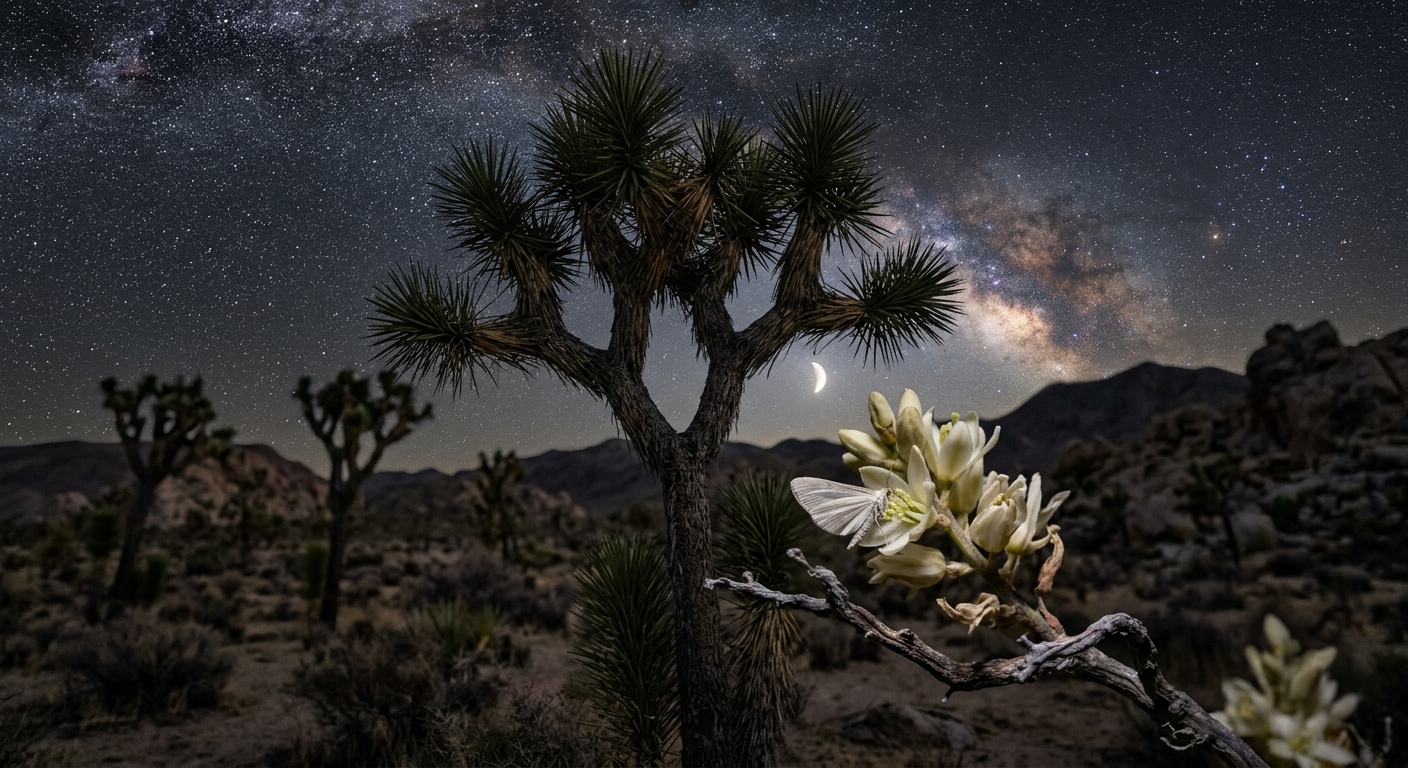
In the stark beauty of the Mojave Desert, an extraordinary love story has been unfolding for millions of years. It’s a tale so intricate and delicate that it makes Romeo and Juliet look like a casual fling. The Joshua tree, that iconic sentinel of the American Southwest, has tied its entire reproductive future to a single partner: the tiny yucca moth. This is one of nature’s most exclusive relationships, and it’s hanging by a thread.
A Partnership Written in Evolutionary Stone
The Joshua tree (Yucca brevifolia) stands as one of the most recognizable symbols of the American desert, with its twisted arms reaching toward the sky like a botanical sculpture. But beneath its alien appearance lies an even more extraordinary secret: this tree cannot reproduce without the help of one specific moth species, Tegeticula synthetica.
This isn’t just a case of a preferred pollinator. The Joshua tree literally cannot produce seeds without this moth. No other insect, bird, or wind can do the job. It’s a biological lock and key system so precise that scientists call it obligate mutualism, where two species have evolved to be completely dependent on each other for survival.
The Intricate Dance of Survival
The relationship between Joshua trees and yucca moths is like a perfectly choreographed ballet that has been performed for millions of years. Here’s how this remarkable process unfolds:
The Moth’s Mission
Female yucca moths have evolved specialized tentacles around their mouths, structures found nowhere else in the insect world. These aren’t just random appendages – they’re sophisticated tools designed for one specific purpose: collecting pollen from Joshua tree flowers and forming it into compact balls.
When a female moth visits a Joshua tree flower, she doesn’t just grab pollen haphazardly. She carefully collects it, using her unique tentacles to shape it into a precise ball that she carries beneath her head. This behavior is so specialized that the moths have lost the ability to eat nectar – their entire mouthpart system has evolved solely for pollen manipulation.
The Perfect Trade
After collecting her pollen ball, the moth flies to another Joshua tree flower to complete her part of the bargain. She climbs deep into the flower and uses her sharp ovipositor to pierce the flower’s ovary, depositing her eggs inside. But here’s where the magic happens: she then climbs to the top of the flower’s pistil and carefully pushes her pollen ball into the stigma, deliberately pollinating the flower.
This behavior is mind-blowing because the moth gains no immediate benefit from pollinating the flower. She’s essentially performing a service for the tree’s future, ensuring that seeds will develop alongside her larvae. It’s one of the few examples in nature where an animal actively pollinates a plant rather than doing so accidentally.
A Delicate Balance of Give and Take
The relationship between Joshua trees and yucca moths represents one of nature’s most sophisticated checks and balances systems. The moth larvae feed on developing seeds, but they don’t consume all of them. Through millions of years of evolution, the moths have developed a self-regulating mechanism that ensures the tree’s survival.
If a moth lays too many eggs in a single flower, the tree will abort that flower, killing all the moth larvae inside. This brutal but effective system has taught the moths restraint. They typically lay only a few eggs per flower, allowing most seeds to mature successfully. It’s a biological contract that benefits both parties: the tree gets pollinated and produces offspring, while the moths get a safe nursery and food source for their young.
When Ancient Partnerships Face Modern Threats
This millions-year-old partnership is now facing unprecedented challenges. Climate change is shifting temperature patterns and rainfall in the Mojave Desert, affecting both Joshua trees and their moth partners in different ways. The moths have shorter life cycles and can adapt more quickly to changing conditions, but the trees are long-lived giants that change slowly.
Rising temperatures are pushing Joshua trees to higher elevations and more northern latitudes, but the moths may not follow the same migration patterns. If the timing of their life cycles falls out of sync, or if they become geographically separated, both species could face extinction.
The Domino Effect
The potential collapse of this relationship would trigger a cascade of ecological consequences. Joshua trees provide crucial habitat for desert wildlife, from nesting sites for birds to shelter for mammals. The Mojave Desert ecosystem has organized itself around these towering sentinels for millions of years.
Without yucca moths, Joshua trees cannot reproduce. Without Joshua trees, entire desert communities would transform beyond recognition. It’s a stark reminder of how the loss of a single, seemingly insignificant species can unravel entire ecosystems.
Nature’s Most Exclusive Club
The Joshua tree and yucca moth partnership represents something profound about the interconnectedness of life on Earth. In a world where we often focus on competition and conflict, this relationship shows us the power of cooperation and mutual dependence.
Every Joshua tree standing in the desert today is a testament to millions of successful partnerships between trees and moths. Each one represents countless generations of moths that faithfully carried out their pollination duties, and trees that honored their part of the bargain by providing food and shelter for moth larvae.
As we face an uncertain future for this ancient partnership, the Joshua tree and its moth remind us that the most extraordinary relationships in nature are often the most fragile. They’ve survived ice ages, droughts, and countless environmental changes together, but they may not survive the rapid pace of modern climate change.
The next time you see a Joshua tree, remember that you’re looking at the product of one of evolution’s most exclusive partnerships. Each twisted branch and spiky leaf exists because of a tiny moth’s dedication to a relationship that began long before humans walked the Earth, and may end long before we’re ready to let it go.