Nature’s Hidden Social Network
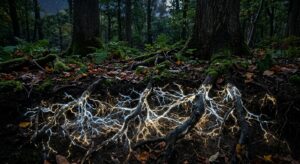
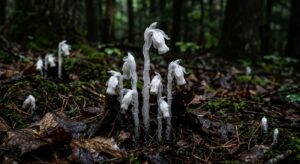
Deep beneath your feet, an extraordinary drama unfolds daily in forests around the world. While we see trees as solitary giants reaching toward the sky, beneath the surface lies one of nature’s most sophisticated communication and resource-sharing networks. This underground internet, made possible by fungal threads thinner than spider silk, reveals that trees are far from the silent, competitive individuals we once believed them to be.
Scientists have discovered that trees actively share nutrients, water, and even warning signals with their neighbors through vast fungal networks called mycorrhizae. Most remarkably, healthy trees will literally keep their dying neighbors alive by pumping resources directly to them through these biological pathways.
The Fungal Internet Explained
The mycorrhizal network operates like a biological version of the internet, earning it the nickname “wood wide web.” This system consists of hair-thin fungal threads called hyphae that form symbiotic relationships with tree roots. The fungi receive sugars and carbon from the trees, while providing essential nutrients like phosphorus and nitrogen in return.
How the Network Functions
These fungal networks extend far beyond individual trees, creating vast underground webs that can span entire forests. A single handful of forest soil contains several miles of these fungal threads, connecting hundreds of trees across different species. The network operates through several mechanisms:
- Nutrient Transfer: Healthy trees pump excess sugars, carbon, and other nutrients through the fungal highways to trees in need
- Water Distribution: During droughts, trees with access to water sources share it with their struggling neighbors
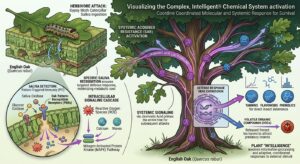
- Chemical Communication: Trees send warning signals about insect attacks, diseases, or environmental stresses
- Defense Coordination: Neighboring trees can pre-emptively boost their immune responses based on chemical alerts
The Altruistic Forest
Perhaps the most mind-blowing aspect of this discovery is how trees behave toward their dying neighbors. Research led by forest ecologist Dr. Suzanne Simard has shown that when a tree is dying, whether from disease, drought, or damage, nearby healthy trees will increase their resource sharing to keep their neighbor alive.
This behavior challenges our fundamental understanding of natural selection. Why would trees waste precious resources on competitors that are already failing? The answer reveals a sophisticated understanding of forest ecology that trees have evolved over millions of years.
The Mother Tree Phenomenon
At the center of many forest networks are ancient “mother trees” or “hub trees” that serve as the network’s central command centers. These giants, often centuries old, are connected to hundreds of other trees and act as resource distribution centers. When younger trees struggle, mother trees will prioritize sending them resources, much like a parent caring for offspring.
Mother trees can even recognize their own seedlings through chemical signatures and will send them more resources than unrelated young trees. This suggests a level of kinship recognition that scientists are only beginning to understand.
Life-Saving Resource Transfers
The mechanics of how trees save their dying neighbors are truly remarkable. When a tree becomes stressed or begins dying, it sends chemical distress signals through the fungal network. Healthy trees respond by increasing their resource transfers, sometimes sending up to 40% of their carbon reserves to their struggling neighbor.
This rescue operation can continue for months or even years. In some cases, trees that should have died from their injuries or infections survive solely because of the constant life support provided by their forest community. Even when trees are clearly beyond saving, their neighbors continue supporting them until the very end.
Cross-Species Cooperation
This altruistic behavior extends across species boundaries. Douglas firs will share resources with paper birches, pines will support oaks, and deciduous trees will aid conifers. The network recognizes need, not species, as the primary factor in resource allocation decisions.
The Science Behind Forest Friendship
Researchers study these networks using sophisticated techniques including radioactive carbon tracking, DNA analysis of fungal networks, and chemical signal detection. By injecting trees with traceable isotopes, scientists can watch in real-time as resources flow through the underground networks.
These studies have revealed that the fungal internet is incredibly dynamic, with resource flows changing based on seasons, weather conditions, and the health status of individual trees. During summer, shaded understory trees receive more resources from canopy trees that have better access to sunlight. In autumn, deciduous trees that are losing their leaves receive support from evergreens that continue photosynthesizing.
Implications for Forest Management
Understanding these networks has revolutionized forest management practices. Traditional clear-cutting methods that remove all trees in an area destroy the fungal networks that took decades to establish. New sustainable forestry practices now aim to preserve these underground connections by maintaining mother trees and minimizing soil disruption.
This research also explains why isolated trees in urban environments or monoculture plantations struggle compared to trees in natural, diverse forests. Without their fungal partners and tree neighbors, individual trees must face environmental challenges alone, making them more vulnerable to diseases, pests, and extreme weather.
The Forest as a Single Organism
These discoveries force us to reconsider what we mean by “individual” trees. If trees share resources, communicate, and coordinate their responses to threats, are we looking at separate organisms or a single, forest-sized superorganism? This perspective aligns with indigenous knowledge systems that have long viewed forests as interconnected communities rather than collections of competing individuals.
The next time you walk through a forest, remember that beneath your feet lies one of nature’s most sophisticated social networks. Every tree around you is connected to every other tree, sharing resources, information, and support in an underground internet that puts our human technology to shame. In this hidden world, no tree dies alone, and the forest truly embodies the principle that together, we are stronger.