Deep in the world of evolutionary arms races, one small beetle has developed perhaps the most explosive defense mechanism on Earth. The bombardier beetle doesn’t just carry chemical weapons, it literally detonates explosive reactions inside its own body and somehow survives the blast. This tiny insect has turned itself into a living chemical laboratory that would make any weapons engineer jealous.
The Anatomy of an Internal Explosion
When threatened, the bombardier beetle performs what can only be described as controlled self-detonation. Inside specialized chambers called reaction vessels, the beetle mixes hydrogen peroxide with hydroquinones in the presence of catalytic enzymes. The result? A violent chemical reaction that reaches temperatures of over 200°F (100°C) and creates pressures that would rupture most biological tissues.
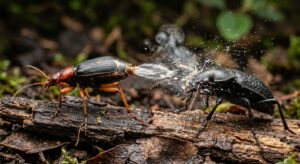
But here’s where it gets truly mind-boggling: this explosion doesn’t kill the beetle. Instead, it creates a superheated, toxic spray that shoots out of the beetle’s rear end at speeds of up to 500 pulses per second. The spray can reach distances of several inches, which might not sound impressive until you consider that we’re talking about an insect smaller than your thumbnail.
The Two-Chamber Defense System
The bombardier beetle’s explosive defense relies on a sophisticated two-chamber system that would impress any chemical engineer. The first chamber, called the reservoir, stores the beetle’s chemical arsenal separately. Here, hydrogen peroxide and hydroquinones wait in stable isolation, like components of a bomb kept safely apart.
When danger strikes, muscular contractions force these chemicals into the second chamber, known as the reaction chamber or explosion chamber. This is where the magic happens. The chamber is lined with cells that produce catalase and peroxidase enzymes, which instantly trigger the explosive decomposition reaction.
The Chemical Recipe for Destruction
The beetle’s internal chemistry reads like a recipe from a demolitions manual:
- Hydrogen Peroxide (H2O2): The same compound used to bleach hair and clean wounds, but in much higher concentrations
- Hydroquinones: Organic compounds that serve as the fuel for the reaction
- Catalase enzyme: Rapidly decomposes hydrogen peroxide into water and oxygen
- Peroxidase enzyme: Oxidizes the hydroquinones into toxic quinones
When these components meet, the hydrogen peroxide instantly decomposes, creating a massive volume of oxygen gas and steam. The rapid expansion of these gases creates the explosive pressure that propels the toxic quinone spray toward the attacker.
Surviving the Blast: Engineering Marvels in Miniature
Perhaps the most incredible aspect of the bombardier beetle’s defense system is how it survives its own chemical warfare. The reaction chamber is reinforced with thick, resilient walls that can withstand repeated explosions. The chamber’s exit valve opens only during the explosion, preventing backflow that could damage the beetle’s internal organs.
The beetle has also evolved precise timing mechanisms. The explosive reaction occurs in rapid pulses rather than one continuous blast, allowing the chamber to cool slightly between detonations. This pulsed firing system prevents the beetle from literally cooking itself from the inside out.
Accuracy and Effectiveness
The bombardier beetle doesn’t just randomly spray and pray. These insects can aim their chemical cannons with remarkable precision, rotating their abdomens to target threats with sniper-like accuracy. The spray is hot enough to cause severe burns and toxic enough to kill smaller predators outright.
Studies have shown that the beetle’s defensive spray is effective against a wide range of predators, including ants, spiders, frogs, and even birds. The combination of heat, toxic chemicals, and the shock of the unexpected explosion is usually enough to send attackers fleeing.
Multiple Species, Multiple Strategies
There are over 500 species of bombardier beetles worldwide, and they’ve evolved variations on this explosive theme. Some species can fire their chemical weapons multiple times in rapid succession, while others have developed different chemical formulations for their sprays.
African bombardier beetles can spray their defensive chemicals in a continuous stream, while their North American cousins prefer the pulsed approach. Some species have even evolved the ability to mix different chemical cocktails depending on the type of threat they’re facing.
Evolutionary Arms Race
The bombardier beetle’s explosive defense system represents millions of years of evolutionary pressure and innovation. This biological arms race has produced one of nature’s most sophisticated chemical defense systems, proving that sometimes the best defense really is a good offense.
Scientists continue to study these remarkable insects, hoping to understand how such complex biochemical systems evolved and how they might inspire new technologies. From pharmaceutical delivery systems to micro-scale propulsion devices, the bombardier beetle’s explosive biology could hold keys to future innovations.
The next time you think about nature’s incredible adaptations, remember the humble bombardier beetle: a tiny insect that solved the engineering challenge of surviving repeated internal explosions millions of years before humans even discovered gunpowder.