The Biological Immortality That Defies Nature
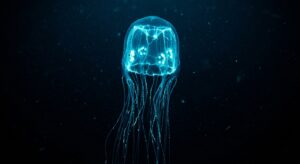
Deep in the world’s oceans swims a creature no bigger than a pinky nail that has achieved something every human has dreamed of: true biological immortality. While we age and die, Turritopsis dohrnii, commonly known as the immortal jellyfish, has discovered nature’s ultimate cheat code, allowing it to literally reverse aging and restart its life cycle whenever death approaches.
This extraordinary ability sounds like science fiction, but it’s very real science. The immortal jellyfish doesn’t just live a long time, it actually reverses its biological clock, transforming from an adult back into a juvenile polyp and beginning life anew. Imagine if humans could become babies again every time they grew old, retaining the ability to mature once more. That’s essentially what this remarkable cnidarian accomplishes.
The Mind-Bending Process of Reverse Aging
The immortal jellyfish’s superpower lies in a process called transdifferentiation, a biological phenomenon so rare and complex that scientists are still unraveling its mysteries. When faced with stress, injury, old age, or starvation, instead of dying like virtually every other creature on Earth, T. dohrnii undergoes a complete cellular makeover.
How Immortality Actually Works
The transformation begins when the adult medusa (the bell-shaped jellyfish we’re familiar with) settles onto the ocean floor. Its bell starts to reabsorb, its tentacles shrivel, and its body literally dissolves into a blob of undifferentiated cells. But this isn’t death, it’s rebirth in reverse.
These cells then reorganize themselves into a polyp, the jellyfish’s juvenile form that looks more like a tiny sea anemone attached to a rock. From this polyp stage, the creature can grow into a mature medusa again, completing a cycle that can theoretically repeat forever. It’s as if a butterfly could transform back into a caterpillar, then become a butterfly again, over and over without end.
The Science Behind Cellular Time Travel
What makes this process so extraordinary is that it requires adult cells to completely change their identity. Muscle cells become nerve cells, reproductive cells become digestive cells, and the entire body plan reorganizes. In most animals, including humans, cells become specialized during development and lose the ability to change into other cell types. T. dohrnii has somehow retained this cellular flexibility throughout its entire life.
Genetic Secrets of Immortality
Recent genetic studies have revealed that the immortal jellyfish possesses several unique adaptations:
- Enhanced DNA repair mechanisms: Extra copies of genes that fix cellular damage
- Telomere maintenance: Ability to prevent chromosome deterioration that normally causes aging
- Stem cell regulation: Superior control over cells that can become any other cell type
- Stress resistance genes: Enhanced ability to survive environmental challenges
These genetic advantages work together to maintain the jellyfish’s cellular machinery in pristine condition, while also preserving the developmental flexibility needed for its remarkable transformation.
From Lab Curiosity to Global Phenomenon
The immortal jellyfish was first discovered in the Mediterranean Sea in the 1880s, but its extraordinary ability wasn’t recognized until the 1990s when marine biologist Ferdinando Boero and his student Christian Sommer made the groundbreaking observation. They noticed that instead of dying, their laboratory specimens were reverting to their polyp stage.
Since then, this tiny creature has spread across the world’s oceans, found everywhere from tropical to temperate waters. Some scientists speculate that their immortality has given them an unprecedented evolutionary advantage, allowing them to colonize new habitats without the usual constraints of mortality.
The Accidental Invasion
Ironically, the immortal jellyfish’s spread around the globe appears to be largely due to human activity. These creatures travel in ship ballast water and can establish new populations wherever they’re released. Their immortality means that even a single individual can potentially start an entire colony, making them remarkably successful invaders.
What Immortality Means for Science
The discovery of T. dohrnii has revolutionized our understanding of aging and cellular biology. Researchers are now studying this jellyfish intensively, hoping to unlock secrets that could help treat age-related diseases in humans. While we’ll never be able to turn back into children like the immortal jellyfish, understanding how it maintains cellular health could lead to breakthroughs in regenerative medicine.
Medical Applications on the Horizon
Scientists are particularly interested in how the immortal jellyfish:
- Prevents cancer despite constant cellular division
- Maintains perfect DNA repair throughout its lifecycle
- Avoids the cellular senescence that causes aging
- Manages to reprogram adult cells without losing cellular control
The Paradox of Practical Immortality
Despite their theoretical immortality, these jellyfish aren’t actually overrunning the oceans. In reality, most don’t live forever because they become food for other marine creatures, succumb to disease, or fall victim to environmental hazards before they need to restart their lifecycle. True immortality in the wild remains as elusive for them as it is for us.
Yet the mere existence of biological immortality in any complex organism challenges our fundamental assumptions about life and death. The immortal jellyfish proves that aging isn’t an inevitable biological law but rather one evolutionary strategy among many. In the vast ocean depths, these tiny creatures continue their endless cycles of life, death, and rebirth, carrying within their simple bodies one of nature’s most profound secrets.
As we continue to study Turritopsis dohrnii, we’re not just learning about a fascinating marine creature, we’re glimpsing possibilities for the future of human health and longevity that once existed only in our wildest dreams.