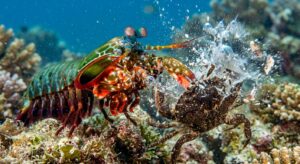
In the depths of tropical and subtropical waters around the world, a seemingly innocent two-inch creature wields one of nature’s most devastating weapons. The pistol shrimp, also known as the snapping shrimp, possesses the extraordinary ability to create bubbles that reach temperatures exceeding 5,000 Kelvin – hotter than the surface of the sun. This microscopic marine assassin has evolved one of the most mind-boggling hunting techniques on our planet.
The Anatomy of a Living Weapon
The pistol shrimp’s secret weapon lies in its dramatically asymmetrical claws. While one claw remains relatively normal in size, the other has evolved into a specialized cannon-like appendage that can grow to be half the size of the shrimp’s entire body. This oversized claw contains a complex mechanism that would make any engineer jealous.
The weapon claw features two main components: a hammer-like plunger and a socket that acts as the barrel. When the shrimp spots potential prey, it cocks back the plunger, storing enormous amounts of energy in specialized muscles. The release mechanism is so precise and powerful that it creates one of the most extreme physical phenomena found in the animal kingdom.
The Physics of Destruction
When the pistol shrimp snaps its claw shut, it doesn’t simply grab its prey. Instead, it creates a high-speed water jet that travels at approximately 60 miles per hour. This jet is so fast that it causes the water pressure to drop dramatically behind it, creating a phenomenon known as cavitation.
The cavitation bubble that forms is where the real magic happens. As this bubble collapses, it creates temperatures that soar beyond 5,000 Kelvin (approximately 8,540 degrees Fahrenheit). To put this in perspective, the surface of the sun reaches about 5,778 Kelvin. For a fraction of a second, this tiny marine creature creates conditions in its immediate environment that are almost as extreme as those found on our nearest star.
The Sonoluminescence Effect
Perhaps even more incredible is that during the bubble collapse, the pistol shrimp actually creates light through a process called sonoluminescence. The collapsing bubble emits a brief flash of light that lasts for just 300 picoseconds. While this light is too brief and faint for human eyes to detect without specialized equipment, it represents one of the most fascinating examples of bioluminescence in nature.
A Hunting Strategy Like No Other
The shockwave produced by the collapsing cavitation bubble is the pistol shrimp’s killing blow. This underwater explosion generates pressures of up to 80,000 pascals and produces a sound that can reach 218 decibels – loud enough to stun or kill small fish, crabs, and other prey within range.
The entire attack sequence happens in less than a millisecond, making it one of the fastest movements in the animal kingdom. Prey animals have virtually no chance to escape once they’re in the pistol shrimp’s crosshairs. The shockwave either kills the target outright or stuns it long enough for the shrimp to move in and finish the job with its smaller claw.
Interestingly, the pistol shrimp doesn’t need to make direct contact with its prey. The cavitation bubble and resulting shockwave can be effective at distances of up to 4 centimeters away from the claw, giving this tiny predator a surprisingly large kill zone.
Evolutionary Marvel
The pistol shrimp belongs to the family Alpheidae, which includes over 600 species of snapping shrimp. Scientists believe this incredible adaptation evolved as a response to the competitive underwater environment where many creatures rely on speed and stealth to catch prey.
What makes the pistol shrimp’s evolution even more remarkable is that if it loses its weapon claw, the smaller claw will gradually transform into the new weapon over several molting cycles. Meanwhile, a new small claw grows to replace the lost appendage. This regenerative ability ensures that the shrimp never loses its primary hunting advantage.
Engineering Inspiration
The pistol shrimp’s unique mechanism has captured the attention of engineers and researchers worldwide. Scientists are studying the biomechanics of the snapping claw to develop new technologies, including:
- Underwater propulsion systems
- High-efficiency water jets for industrial cleaning
- Sonochemical reactors for chemical processing
- Novel approaches to underwater acoustics
Living Alongside Giants
Despite their fearsome hunting abilities, many pistol shrimp species have evolved fascinating symbiotic relationships with other marine creatures. Perhaps most notably, several species form partnerships with goby fish. The nearly blind shrimp excavates and maintains a burrow that both animals share, while the goby acts as a lookout for predators, alerting its roommate to danger with specific tail movements.
This partnership demonstrates that even the ocean’s most efficient micro-predators benefit from cooperation and mutual assistance in the complex underwater ecosystem.
A Reminder of Nature’s Ingenuity
The pistol shrimp serves as a powerful reminder that some of nature’s most extraordinary adaptations come in the smallest packages. In a world where we often focus on massive predators like sharks and whales, this tiny crustacean proves that innovation and lethality aren’t always about size.
The next time you’re near a coral reef or rocky coastline in warm waters, remember that somewhere nearby, these remarkable creatures are creating their own miniature suns with every snap of their claws, continuing one of evolution’s most ingenious solutions to the fundamental challenge of survival in the sea.