Long before Disney’s animatronics or modern theater automation, the ancient Greeks created something that would seem like pure magic to their audiences: fully automated theaters that performed entire plays without a single human actor on stage. These mechanical marvels, known as automata theaters, represented one of the most sophisticated examples of ancient engineering and entertainment technology.
The Mastermind Behind Ancient Robot Theater
The genius behind these automated performances was Hero of Alexandria, a Greek mathematician and engineer who lived in the 1st century CE. Hero wasn’t just a dreamer; he was a practical inventor whose works included the first recorded steam engine, automatic doors, and programmable machines. His automata theaters, however, may have been his most impressive achievement.
Hero documented his mechanical theater designs in a work called “Automata,” where he described two types of automated performances: stationary displays and mobile theaters that could move from place to place. These weren’t simple wind-up toys but sophisticated machines capable of performing complex sequences of movements and actions.
How Ancient Robots Brought Stories to Life
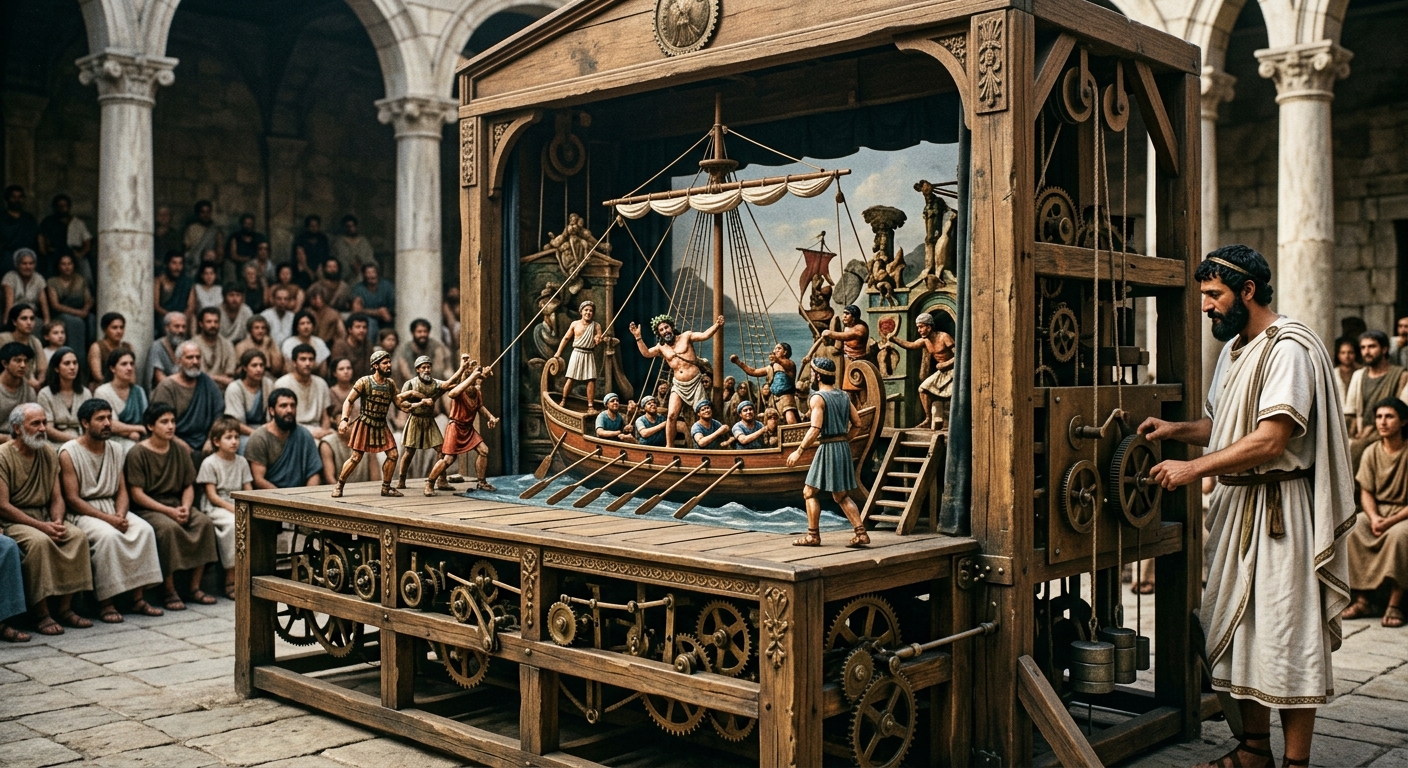
The mechanics behind these ancient robot theaters were ingeniously simple yet remarkably effective. The entire system relied on a network of ropes, pulleys, weights, and drums, all powered by a slowly falling weight system similar to what you’d find in a grandfather clock.
The Programming System
What made Hero’s theaters truly revolutionary was their programmability. He used a cylindrical drum wrapped with rope in specific patterns. As the drum rotated, different sections of rope would tighten or loosen, triggering various mechanical actions throughout the theater. This was essentially binary programming using physical materials, predating modern computer programming by nearly two millennia.
The Performance Elements
These automated theaters could produce an astonishing array of effects:
- Figures that moved across the stage in predetermined patterns
- Doors that opened and closed at precise moments
- Thunder sounds created by falling metal balls
- Lightning effects using reflective surfaces
- Automated music from mechanical instruments
- Scene changes with rotating backdrops
- Figures that appeared and disappeared through trapdoors
The Nauplius: A Masterpiece of Ancient Automation
One of Hero’s most famous automated plays was “The Nauplius,” which told the tragic story of the Trojan War’s aftermath. This 10-minute performance featured multiple scenes with dozens of automated figures, complete with a shipwreck, funeral pyre, and divine intervention.
The play opened with Greek ships sailing across the stage, their movement controlled by hidden mechanisms. Lightning would flash as the god Athena appeared, followed by a dramatic shipwreck scene where figures were thrown into mechanical waves. The finale featured Ajax emerging from the wreckage and ultimately destroying himself, all performed by intricate mechanical figures.
Technical Specifications That Astound Modern Engineers
Modern reconstructions of Hero’s designs have revealed just how sophisticated these machines were. The timing mechanisms were accurate to within seconds over the course of a 10-minute performance. The gear ratios were calculated with mathematical precision to ensure smooth operation. Some historians believe these theaters may have inspired the term “deus ex machina” (god from the machine), as divine figures would literally appear from mechanical contraptions.
Beyond Entertainment: The Deeper Purpose
While these automated theaters certainly entertained audiences, they served multiple purposes in ancient Greek society. They demonstrated the mathematical and engineering prowess of Greek civilization, served as religious offerings in some contexts, and provided a way to tell important cultural stories in a standardized format.
The theaters also had practical advantages. Unlike human performers, mechanical actors never forgot their lines, couldn’t demand higher pay, and performed exactly the same way every time. This consistency was particularly valuable for religious ceremonies where precision was crucial.
Lost Technology Rediscovered
For centuries, Hero’s automated theaters existed only in ancient texts that many dismissed as fantasy or exaggeration. It wasn’t until the 20th century that scholars began taking these descriptions seriously and attempting reconstructions. Modern engineers who’ve built working replicas have been amazed by the sophistication of the original designs.
The technology Hero developed was essentially lost after the fall of the Roman Empire, not to be rediscovered until the Renaissance when European clockmakers began creating similar automated figures. In many ways, Hero’s theaters represented a technological peak that wouldn’t be matched for over a thousand years.
Legacy of Ancient Automation
Today’s programmable machines, from industrial robots to theme park attractions, owe a debt to Hero’s pioneering work. His use of programmable drums and rope systems established principles that would later influence the development of player pianos, early computers, and modern robotics.
The automated theaters also represented an early example of what we now call “mixed reality” entertainment, blending physical mechanical effects with narrative storytelling in ways that fully immersed audiences in the performance.
Perhaps most remarkably, these ancient robot theaters remind us that the human drive to create, to automate, and to tell stories through technology is nothing new. Over 2,000 years ago, Greek engineers were already imagining and building the kind of automated entertainment that we think of as thoroughly modern. In doing so, they created not just impressive machines, but a bridge between the ancient world’s mechanical ingenuity and our own digital age.