When Nature Becomes a Master Sculptor
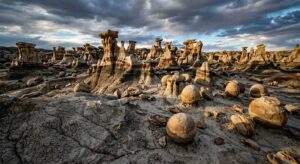
Along the rugged coastline of New Zealand’s South Island, scattered across Koekohe Beach like forgotten marbles from a giant’s game, lie some of the most mysterious geological formations on Earth. The Moeraki Boulders appear so perfectly spherical, so unnaturally round, that many visitors assume they must be artificial. But these massive stone orbs tell a story that spans millions of years, revealing one of nature’s most patient and extraordinary sculpting processes.
These aren’t just rocks. They’re time capsules, geological masterpieces that began their formation on the ancient seafloor when dinosaurs still roamed the Earth. Each boulder represents a testament to the incredible forces that shape our planet, forces so gradual and persistent that they can transform loose sediment into perfect spheres weighing several tons.
The 4-Million-Year Journey Begins
The story of the Moeraki Boulders begins approximately 60 million years ago, during the Paleocene epoch, in the depths of an ancient ocean. At this time, the area that would become New Zealand’s South Island lay beneath hundreds of meters of seawater. On the muddy ocean floor, a remarkable process was about to begin.
The formation process, known as concretion, started when organic matter, tiny shells, and other debris settled into the seafloor sediments. These organic materials acted as nucleation points, similar to how pearls form around irritants in oysters. However, instead of the rapid formation of a pearl, the Moeraki Boulders would require millions of years to reach their current size.
The Chemistry of Stone Spheres
As layers of sediment accumulated on the ocean floor, groundwater rich in dissolved minerals began to circulate through the mud. The key player in this geological drama was calcium carbonate, which slowly precipitated out of the water and began to cement the sediments together around the organic nuclei.
This process occurred grain by grain, molecule by molecule. The calcium carbonate didn’t just randomly stick to any available surface. Instead, it followed the laws of physics and chemistry, creating the most structurally stable shape possible: a sphere. This is the same principle that makes soap bubbles round and explains why planets are spherical.
From Seafloor to Spotlight
For millions of years, these growing stone spheres remained buried beneath the ocean floor, slowly increasing in size as more minerals crystallized around them. The surrounding mudstone, meanwhile, was also forming through the compression and cementation of seafloor sediments, but it remained much softer than the increasingly hard boulder cores.
The dramatic transformation of this underwater landscape began around 15 million years ago when tectonic forces lifted the entire region above sea level. What had once been ocean floor became dry land, but the boulders remained hidden, entombed within layers of mudstone that were hundreds of meters thick.
The Great Reveal
The final chapter in the Moeraki Boulders’ journey to fame began only recently in geological terms. Over the past few million years, relentless coastal erosion has been slowly wearing away the softer mudstone cliffs. As the waves crashed against the shore day after day, year after year, they gradually exposed these hidden treasures.
When the erosion finally reaches a buried boulder, the contrast becomes immediately apparent. The hard, spherical concretion resists weathering far better than the surrounding mudstone, eventually tumbling onto the beach as a nearly perfect sphere. Some boulders are still partially embedded in the cliff face, like stone eggs waiting to hatch from their rocky nests.
A Gallery of Geological Wonders
Today, visitors to Koekohe Beach can observe boulders in various stages of this revealing process. The largest specimens reach up to 2 meters in diameter and weigh several tons. Their surfaces display fascinating patterns that tell the story of their formation:
- Honeycomb weathering patterns: Small holes and indentations created by salt crystallization
- Calcite crystal veins: Light-colored lines that show where mineral-rich water flowed during formation
- Septarian cracks: Some boulders display dramatic internal fractures filled with different colored minerals
- Fossilized remains: Occasional ancient marine life embedded in the boulder structure
The Science Behind the Spheres
What makes the Moeraki Boulders truly exceptional isn’t just their size, but their remarkable sphericity. Scientific measurements have revealed that many of these natural sculptures deviate less than 1% from perfect spheres. This level of precision rivals that of manufactured objects and demonstrates the incredible consistency of the natural processes that formed them.
The spherical shape results from the uniform growth pattern of the concretion process. As minerals precipitated from the groundwater, they were deposited equally in all directions from the central nucleus, creating expanding spheres of cemented sediment. This process continued for approximately 4 million years, making these boulders some of the most patient artworks on Earth.
Beyond New Zealand: A Global Phenomenon
While the Moeraki Boulders are perhaps the most famous example of large spherical concretions, similar formations exist around the world. From the cannonball concretions of North Dakota to the stone spheres of Costa Rica, our planet has produced these mysterious orbs through various geological processes.
However, few locations combine the size, quantity, and accessibility of the Moeraki Boulders. Their position on an easily accessible beach, combined with their impressive scale and near-perfect preservation, makes them a unique window into deep geological time.
Guardians of Deep Time
The Moeraki Boulders serve as powerful reminders of the vast timescales on which our planet operates. In our human perspective, these stones appear eternal and unchanging. Yet they represent just one moment in an ongoing geological story that spans hundreds of millions of years. The same forces that created them continue to work today, forming new concretions in ocean sediments around the world.
As climate change and rising sea levels threaten coastlines globally, the continued erosion of the cliffs at Koekohe Beach will likely reveal more boulders in the years to come. Each newly exposed sphere will carry its own 4-million-year journey from the ancient seafloor to the modern world, adding new chapters to one of geology’s most fascinating stories.