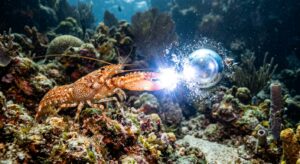
Deep beneath the tropical waters of the Indo-Pacific, a creature exists that makes our human vision seem as primitive as black and white television. The mantis shrimp, despite its misleading name, isn’t actually a shrimp at all – it’s a stomatopod, and it possesses the most complex color vision system known to science.
While we humans pride ourselves on our advanced visual capabilities, we’re essentially colorblind compared to these marine marvels. Our eyes contain just three types of color photoreceptors, allowing us to see combinations of red, green, and blue. The mantis shrimp? It boasts an astounding 16 different types of color receptors, opening up a visual world so rich and complex that our brains literally cannot process what they’re seeing.
The Alien Eyes That Shame Human Vision
Imagine trying to describe the color red to someone who has only ever seen in black and white. That’s essentially the challenge scientists face when attempting to understand mantis shrimp vision. These creatures can perceive ultraviolet light, infrared radiation, and even polarized light in ways that would seem like supernatural powers to us.
Each of the mantis shrimp’s compound eyes contains up to 10,000 individual photoreceptive units called ommatidia. But here’s where it gets truly mind-bending: each eye can move independently of the other, meaning they can literally look in two different directions simultaneously while processing an incomprehensible spectrum of visual information.
The Science Behind Superhuman Sight
Dr. Justin Marshall, a sensory biologist at the University of Queensland, has spent decades studying these creatures. His research reveals that mantis shrimp eyes are structured unlike anything else in the animal kingdom. The middle section of their eyes contains specialized rows of photoreceptors, each tuned to different wavelengths of light.
While humans see the world through combinations of three primary colors, mantis shrimp process visual information through:
- Deep ultraviolet light – wavelengths completely invisible to human eyes
- Twelve different types of color receptors in the visible spectrum
- Linear and circular polarized light – imagine seeing the “grain” of light itself
- Infrared radiation – detecting heat signatures like living thermal cameras
What Does the World Look Like Through Their Eyes?
Scientists have attempted to simulate mantis shrimp vision using advanced computer modeling, but the results are frustratingly inadequate. It’s like trying to play a symphony through a kazoo – the complexity simply cannot be captured by our three-color visual system.
Consider a simple coral reef scene. Where humans might see colorful fish swimming among vibrant corals, a mantis shrimp perceives layers upon layers of additional information. They can see the polarized light signatures that help them identify different species, detect the ultraviolet patterns that serve as secret communication channels between sea creatures, and spot the subtle color variations that reveal the health, mood, and intentions of potential prey or predators.
The Polarized Light Advantage
Perhaps most fascinating is their ability to see polarized light with incredible precision. Light waves normally vibrate in all directions, but polarized light waves vibrate in specific patterns. Mantis shrimp can detect these patterns in ways that give them almost X-ray-like vision through water.
This ability allows them to see through the camouflage of transparent prey, detect reflective fish scales that would otherwise blend into the background, and even communicate with other mantis shrimp through polarized light signals invisible to predators and prey alike.
Nature’s Most Sophisticated Visual System
The mantis shrimp’s visual system is so advanced that it’s inspiring cutting-edge technology development. Engineers are studying their eyes to develop better:
- Satellite imaging systems
- Medical diagnostic equipment
- DVD and Blu-ray players
- Underwater cameras and sensors
The University of Illinois has even developed experimental cameras based on mantis shrimp vision that can detect cancer cells more effectively than traditional medical imaging.
The Paradox of Perception
Ironically, recent studies suggest that despite having 16 types of color receptors compared to our three, mantis shrimp might not actually see more colors than humans do. Instead, their visual system appears optimized for incredibly rapid color recognition rather than fine color discrimination.
Think of it this way: while humans carefully blend their three types of color input to create millions of subtle hues, mantis shrimp have dedicated “channels” for quick identification. They sacrifice color subtlety for speed and accuracy – a perfect adaptation for creatures that need to make split-second decisions about whether something is food, friend, or foe.
Living Rainbows in an Invisible World
The next time you look at a rainbow and marvel at its beauty, remember that you’re seeing only a tiny fraction of what’s actually there. In the same patch of sky, a mantis shrimp would perceive layers of ultraviolet patterns, polarized light displays, and color combinations that don’t even have names in human language.
These remarkable creatures remind us that reality is far stranger and more beautiful than our limited human senses can detect. They’re living proof that there are entire worlds of experience happening all around us, invisible and unimaginable, in the depths of our planet’s oceans.
In a universe full of wonders, the mantis shrimp stands as a humbling reminder that we’ve barely scratched the surface of understanding the sensory capabilities that evolution has crafted over millions of years. They are the ultimate testament to the fact that our planet still holds secrets that can fundamentally change how we see – quite literally – the world around us.